
Abstract
Writing a dissertation is often the hardest hurdle in any academic journey. If you feel like you are stuck in the middle of a dissertation, you’re not alone—and it’s usually due to the process itself, not your ability. This guide helps you clear those roadblocks. Discover how an expert tutor can help you refine your research, simplify your workflow, and stay on track until you’ve successfully defended your thesis.
Key Takeaways
- Getting stuck is usually about the process, not you. Confusion over methods, tackling too big a topic, and feeling isolated are the real culprits behind projects that have hit a plateau.
- Know the difference in support. A university supervisor is there to check your work against institutional rules, while a dissertation tutor provides the hands-on, subject-specific help you need to actually write and improve your work.
- One size doesn’t fit all. Tutoring, mentoring, coaching, and editing help with different problems at different stages of your research.
- Bring your drafts. When you send your work to your tutor before you meet, you get deep, helpful feedback instead of just a quick proofread.
- Beat the isolation. Perfectionism and imposter syndrome thrive in silence. Getting external accountability is the fastest way to get your momentum back.
Writing a dissertation is typically regarded as one of the biggest academic challenges a person can undertake. The dissertation is the culminating product of your independent study, critical thinking, and perseverance, whether the qualification sought is a bachelor’s, master’s or doctoral award (Almusaed, Almassad and Yitmen, 2025). After months of preparation, however, an idea that once felt compelling frequently becomes a source of anxiety, undermined by writer’s block, methodological confusion, or prolonged isolation. The key to overcoming these obstacles with confidence is sustained work with an expert dissertation tutor.
This extensive guide will examine why dissertations often get difficult, how expert academic advising enhances the research journey, and the advantages of using intentional support to help you finish your project.
The Anatomy of Dissertation Stress: Why Students Struggle
Writing a dissertation is different from any other academic work that you have ever written. So far in class, you have followed a format in which your class assignments are typically based on a set of essay prompts, a well-structured weekly reading, and relatively short turn-in deadlines. In the dissertation, on the other hand, you will be expected to produce new, self-generated scholarship. This “change” brings in some psychological and structural barriers:
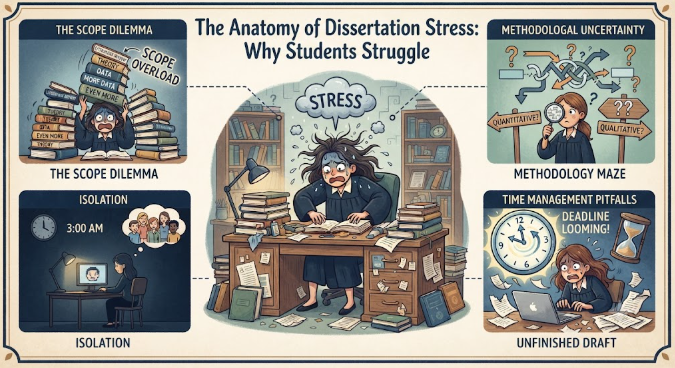
- The Scope Dilemma: Students often try to answer questions that are too big and end up reading and gathering too much information and data to handle.
- The dissertation process is often a solitary journey, done behind closed doors, compared with the taught modules, where students interact with their peers and professors regularly.
- Methodological Uncertainty: Classroom lectures might not equip you with all the expertise you need to design a good research method, whether quantitative, qualitative, or mixed research.
- Procrastination: It is easy to forget to set deadlines and then rush through the work at the last minute, producing work that is less than your best.
Understanding these issues can be the first step towards a sustainable solution. Independent academic support is the key to making learning independent and structured.
Defining the Spectrum of Academic Support
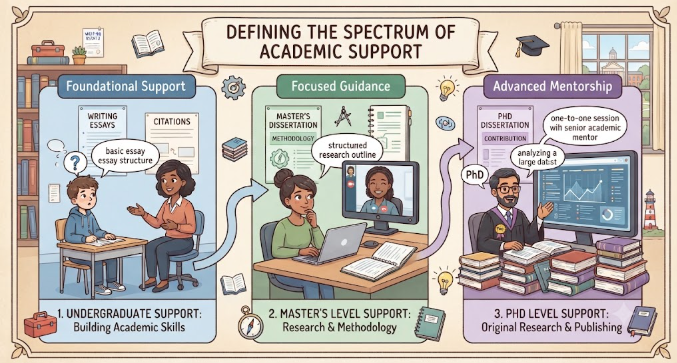
It is important to understand the language and types of support when searching for external guidance. There are specific roles available within the academic support industry that aim to address specific points of the research lifecycle.
Dissertation Tutor and Online Dissertation Tutor
The online dissertation tutor offers particular instruction that suits your research subject and academic field. This expertise is available online, providing a dissertation tutor who can guide students from anywhere, even those in high-level studies. Your tutor will explain tricky concepts, give you feedback on your outline, and guide you through your arguments.
Professional and Academic Dissertation Tutors
They are experts in their respective fields who assist students with their dissertations. The professional dissertation tutor brings industry knowledge and high-level pedagogical approaches to the table, helping you develop an academic voice with enhanced quality. An academic dissertation tutor pays attention to the institution’s standards, strict referencing, and a high standard of academic writing.
Dissertation Tutoring and Mentoring
Dissertation mentoring and online dissertation mentoring differ from tutoring, which tends to emphasise a particular technical skill, like statistical analysis or literature synthesis. A mentor offers guidance, provides confidence, and helps you through the ups and downs of the research experience.
Specialised Coaching and Supervision Support
- Dissertation Coaching/Dissertation Writing Coach: on productivity, time management, mindset, and overcoming procrastination to keep the writing momentum going.
- Dissertation Supervision Support/Research Project Supervision Support: Provides additional support for your advisor to help you achieve your university’s milestones and respond to feedback.
- Tiered Expertise: Research Dissertation Tutor/Master’s Dissertation Tutor/PhD Dissertation Tutor/Undergraduate Dissertation Tutor: provides level-specific skills suited to the needs of your particular degree level, ranging from basic undergraduate methodologies to thorough doctoral contributions.
- One-to-One Dissertation Tutoring: Provides individual, undivided tutoring tailored to meet your research needs.
- Dissertation Editing and Feedback: Line-by-line edits and feedback on your drafts to refine your writing, remove ambiguity, and enhance the scholarly tone. Established platforms such as The Academic Papers UK offer professional dissertation editing services, constructive feedback, and one-to-one dissertation tutoring.
How Expert Guidance Transforms Your Research Process
A specialised academic mentor can alter the direction of your project in several key ways. Let’s see how professional advice can improve the quality and speed of dissertation completion.
Research question and its scope
A good dissertation always has a well-defined, defensible research question. In too many cases, students select a subject for their report that is too broad to be properly treated within the time limit. You will have the support of an experienced guide, who will help you focus your research and make it both feasible and useful to your discipline.
Navigating Complex Methodologies
Even the most committed student can be daunted by choosing daunting tasks. Whether a study relies on qualitative interviews, quantitative surveys or a systematic literature review, each approach carries distinct procedural requirements. Specialised instruction ensures that the chosen methodology is robust, ethical and defensible at the viva.
Properly Writing a Cohesive Literature Review
One mistake that students make when writing their dissertation literature review is that they do not include a critical analysis of the knowledge they have summarised from various books and articles; instead, they only summarise and do not analyse. Expert guidance helps you map out themes, identify gaps in the literature, and clarify where your study fits in the academic context.
The development of an Academic Voice
There is a clear need for a precise, objective, and authoritative style in writing at the undergraduate, master’s, or doctoral level. You will be provided with detailed feedback and collaborate to remove colloquial phrases, make your argumentation stronger, and present complex information clearly and precisely
The 5-Minute Momentum Check
The secret to sustaining progress often lies in the ‘5-Minute Momentum Check.’ Before starting a writing session, spend exactly five minutes reviewing your outline and identifying one specific, small goal—like writing a single paragraph or refining one citation. This micro-goal removes the paralysis of staring at a blank page, turning an overwhelming project into manageable, actionable steps that expert tutors help you define and track.
Practical Strategies for Working with Your Academic Mentor
| Strategy | Actionable Implementation | Primary Benefit |
| Establish Clear Objectives | Define the specific hurdle (e.g., outline structure, statistical interpretation) before each session. | Ensures focused, high-value discussion without wasted time. |
| Submit Work in Advance | Provide draft materials early to allow for thorough review and deep analytical feedback. | Shifts meeting focus from quick proofreading to substantive critique. |
| Embrace Constructive Criticism | Treat editorial suggestions as tools to elevate research to publication standards rather than personal critiques. | Accelerates skill development and strengthens overall argumentation. |
| Maintain Consistent Momentum | Schedule regular check-ins to enforce steady weekly progress instead of last-minute writing sprints. | Prevents severe bottlenecks, burnout, and chronic procrastination. |
Overcoming Psychological Barriers: The Mental Game of the Dissertation
Beyond the technical and structural difficulties, writing a dissertation is a mental marathon. Incomplete projects are the result of contributing factors like imposter syndrome, perfectionism and burnout.
Beating Imposter Syndrome
Many students with high grades feel inadequate to do such a project. They are unsure if their research is “original” enough or if they have enough authority to write about the topic. An experienced guide can be a reality check, provide a sense of legitimacy to your work, and remind you that a dissertation is a learning experience about how to research, not an obligation to revolutionise your field by yourself.
Managing Perfectionism
The fear of a first draft that could be done better is the worst foe to completion. A “write now, polish later” approach is taught with the help of expert coaches, who help you learn how to break down the drafting process from the revision process.
Conclusion: Taking Control of Your Academic Future
You do not have to have a dissertation that takes over your mental state and your personal life. Whether it is the benefits of highly structured coaching, or more focused methodological training, or the rigorous feedback in the field of editing, you have resources in your hands to face the challenges of advanced academic research. When you invest in your project with professional academic support, you are investing in quality, efficiency and peace of mind. When you have a clear roadmap, consistent mentorship and unshaking determination, you can realise your research dreams and produce a polished, successfully defended dissertation for which you will be proud for a lifetime.
FAQs
How can a dissertation tutor help with research?
A subject expert tutor guides you through each stage of the research process. They can help you narrow down the general concept you are interested in into specific research questions, assess scholarly texts, effectively integrate information from a variety of sources, and take your investigation from start to finish while keeping it at an academic level.
Can a dissertation tutor help with topic selection?
Yes. Deciding on a relevant, interesting, and unique subject is one of the most important parts of the dissertation process. A tutor helps you assess feasibility, scope, and significance to make sure that your topic is accepted as part of your degree and can be accomplished within your time.
What is the difference between a dissertation tutor and a supervisor?
The main difference is that they are institutional and the type of support they offer. The university supervisor is a designated representative from your academic department to monitor your progress, ensure compliance with university guidelines, and ultimately assess and grade your final work. A dissertation tutor, on the other hand, is an independent academic guide who provides one-on-one guidance and training, technical skills development, editorial comments, and coaching that is specialised to your personal learning and research requirements.
Can a dissertation tutor review a dissertation draft?
Yes. Tutors will review your working drafts, giving you valuable comments on clarity, academic tone, argumentative transitions, coherence of structure, and use of professional referencing and formatting.
Do dissertation tutors help with data analysis and methodology?
Yes. Tutors provide expert research design Instruction, helping you choose the most appropriate quantitative, qualitative, or mixed methods. They can also help design research questionnaires and interview guides, and explain complex statistical output.
How do online dissertation tutor sessions work?
Online tutoring sessions are usually conducted through a secure video conferencing service with screen sharing and co-browsing features. You present your draft materials or questions beforehand, and the session is devoted to reviewing feedback, clarifying complicated material, and outlining concrete steps for the next stage of your writing.
READ MORE: clocktimes