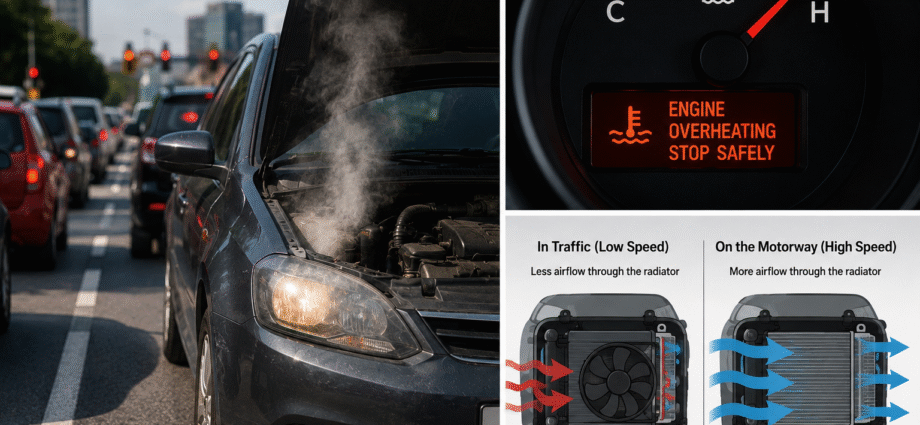
If your car overheats in traffic but runs at a normal temperature on the motorway, the difference in speed is an important clue. At higher speeds, natural airflow helps move air through the radiator and cool the engine. In slow-moving traffic or while idling, that airflow drops significantly, so the cooling system has to rely more heavily on components such as the cooling fan and coolant circulation.
This means a car can appear completely healthy on a motorway while still having a cooling system fault that becomes obvious as soon as you slow down. A faulty cooling fan, temperature sensor, low coolant level, restricted radiator or weak water pump can all contribute to this pattern.
This guide explains why your car may overheat in traffic but not at higher speeds, the most likely causes, how the fault is diagnosed and what you should do before overheating causes serious engine damage.
The Basic Reason Behind This Pattern
At motorway speeds, air flows through the radiator naturally as the car moves, providing plenty of cooling without much extra help needed. In traffic, however, there is little to no natural airflow, so the cooling system relies heavily on the cooling fan to draw air through the radiator instead.
If anything in that fan-dependent process is not working correctly, the car can run perfectly fine at speed while still overheating the moment it slows down or idles for any length of time. This single distinction explains the majority of cases where overheating appears only in traffic, and it is worth understanding properly before looking at the individual causes below.
How Your Cooling System Changes Behaviour With Speed
It helps to picture the cooling system working in two slightly different modes depending on how fast the car is travelling. At speed, moving air is doing much of the work for free, pushing through the radiator with enough force that even a slightly underperforming fan or a marginally low coolant level rarely causes a problem. The system essentially gets outside help.
At idle or low speed, that free assistance disappears almost entirely. The engine still produces the same amount of heat, sometimes more, given the extra load of idling with the air conditioning running, but now the cooling system has to manage that heat using only its own internal components, principally the fan and the coolant circulation itself. Any weakness that was previously hidden by airflow at speed becomes the limiting factor.
If your car repeatedly overheats in traffic, arranging car repairs in Fleet can help identify the underlying fault before it develops into more serious engine damage. A technician can inspect the cooling fan, coolant level, radiator, water pump and related components to determine why the problem appears at low speeds but disappears once the car is moving faster.
Common Causes of Overheating Specifically in Traffic
1. Faulty Cooling Fan
This is the most frequent explanation. If the electric cooling fan fails to activate, or only partially works, the engine loses its main source of airflow at low speeds. At motorway speeds, natural airflow compensates, masking the fault entirely until traffic slows things down. A fan that runs constantly, never switches off, or makes an unusual noise is a sign worth listening for, even before overheating becomes obvious.
2. Faulty Fan Temperature Sensor
Even a fully functional fan will not help if the sensor responsible for triggering it is faulty. If this sensor fails to detect rising temperature accurately, the fan may not switch on when it should, despite the engine genuinely needing the extra cooling. This fault can be particularly frustrating to diagnose, since the fan itself tests as perfectly healthy when checked in isolation.
If the fan works when tested directly but does not switch on as the engine temperature rises, the control circuit or temperature sensor may need further investigation.
3. Low Coolant Level
A slightly low coolant level can sometimes still provide enough cooling at speed, where airflow does much of the work, but becomes insufficient once the car relies more heavily on the fan and circulation alone.
This is a common reason mild coolant loss goes unnoticed until traffic conditions expose it, and it is one of the easiest causes to rule out with a simple visual check.
A low coolant level should not simply be topped up repeatedly without finding the reason for the loss. A leak, damaged hose, radiator problem or another cooling-system fault may be responsible.
4. Blocked or Dirty Radiator
Debris, insects and road grime can build up on the radiator over time, restricting airflow even when the fan is working correctly. At motorway speeds, the sheer volume of air moving through can partially compensate for a partially blocked radiator, whereas in traffic, that airflow advantage disappears and the restriction becomes far more noticeable.
Internal blockage can also restrict coolant flow even when the outside of the radiator looks clean, so a visual inspection alone cannot always rule out a radiator problem.
5. Weak Water Pump Performance
A water pump that is beginning to wear, but not yet failed, may still circulate coolant adequately at higher engine speeds. At idle or low revs, however, its reduced output can be enough to allow heat to build up faster than the system can manage. This is a gradual fault, so drivers sometimes notice the traffic overheating pattern worsening slowly over several weeks.
6. Auxiliary Belt Issues
If the belt driving the water pump or fan is slipping, worn or not tensioned correctly, its performance can vary with engine speed. This sometimes means adequate circulation at higher revs on the motorway, but insufficient circulation at the lower engine speed typical of idling in traffic. A squealing noise, particularly when starting the engine from cold, can be an early clue.
If the belt is slipping or damaged, the water pump may not operate at the speed required for effective coolant circulation. A damaged belt can also create a more serious breakdown risk if it fails.
Why This Pattern Can Be Misleading
Because the car runs perfectly fine at speed, it is easy to assume the cooling system is healthy overall, when in fact only part of it is working correctly. This is one of the more deceptive overheating patterns, since a driver might reasonably conclude there is no fault at all if they only drive long motorway stretches and rarely sit in traffic.
The risk here is that whatever component is struggling, whether the fan, sensor or radiator, will not improve on its own, and will very likely start affecting performance at higher speeds too as the underlying wear progresses. Treating this as a genuine early warning, rather than a strange quirk of the car, is the more sensible approach.
How This Differs From General Overheating
General overheating, which appears at both low and high speeds, tends to point toward a broader issue such as significantly low coolant, a stuck thermostat, or a major leak, none of which are speed-dependent. Traffic-specific overheating, by contrast, narrows the likely cause considerably toward the fan, its sensor, or airflow restriction, since these are the components whose effectiveness genuinely changes with vehicle speed.
Recognising which pattern you are experiencing is a useful first step before any diagnosis even begins, as it immediately rules out several possibilities and helps a technician focus their check more efficiently.
Traffic Overheating: Common Causes at a Glance
| Cause | Why It Shows Up in Traffic Specifically |
| Faulty cooling fan | No natural airflow to compensate at low speed |
| Faulty fan sensor | Fan does not activate when genuinely needed |
| Low coolant level | Airflow at speed masks a marginal shortfall |
| Blocked radiator | Motorway airflow partially compensates, traffic does not |
| Weak water pump | Reduced circulation more noticeable at idle |
| Auxiliary belt issues | Performance varies with engine speed |
Comparing Traffic Overheating and General Overheating
The table below sets out how the two patterns typically differ, which can help you describe the symptom accurately when booking a check.
| Feature | Traffic Specific Overheating | General Overheating |
| Occurs at idle or low speed | Yes | Yes |
| Occurs at motorway speed | No, or rarely | Yes |
| Likely cause | Fan, sensor, radiator airflow | Coolant level, thermostat, major leak |
| Typical onset | Gradual, worsens with fan wear | Can appear suddenly with a leak |
| Resolves once moving | Often yes | Usually no |
What to Do if This Happens to You
If your temperature gauge starts rising in traffic, first note whether it returns towards normal once the vehicle begins moving again. This pattern is useful information for a technician because it can help narrow down the likely cause. If the temperature continues to rise, avoid remaining stationary with the engine running and air conditioning on full.
If the gauge approaches the red zone or a temperature warning appears, find a safe place to stop as soon as possible and switch the engine off. Do not remove the coolant reservoir cap while the engine is hot, as the cooling system may be pressurised and hot coolant can cause serious burns.
Allow the vehicle to cool before checking the coolant level, following the manufacturer’s instructions. If coolant is very low, there is visible steam, the warning returns quickly, or the temperature continues to rise, do not continue driving. Arrange professional assistance instead.
Even if the temperature returns to normal once you reach motorway speed, the underlying problem should still be investigated rather than treated as a harmless traffic-only issue.
Booking the car in for a proper check as soon as convenient is the sensible next step, since this specific pattern usually points toward a fault that a technician can identify fairly quickly. You can also check TJ Services Fleet on Google for the garage location, opening information and customer reviews before arranging your visit.
How This Is Diagnosed and Fixed
A technician will normally begin by checking whether the cooling fan activates correctly as the engine reaches operating temperature. The fan, fan control system and temperature sensor can then be tested to determine whether the fan is receiving the correct signal and operating as expected.
The coolant level and condition should also be checked, along with the radiator, hoses, water pump and auxiliary belt. If a coolant leak is suspected, the cooling system may need further testing to identify where coolant is escaping. A radiator can also require inspection for external blockage or internal flow problems.
A controlled test may then be used to reproduce the overheating condition and confirm whether the problem occurs mainly at idle or low speed. This helps distinguish a traffic-specific cooling fault from a wider overheating problem.
Once the underlying cause has been identified, the appropriate component can be repaired or replaced rather than simply treating the overheating symptom.
Experienced technicians at TJ Services Fleet can check the cooling fan, temperature sensor, coolant level, radiator and related components to identify why the vehicle is overheating specifically in traffic.
Why This Should Not Be Left Unaddressed
Even though the car may seem to run perfectly well outside of traffic, this pattern of overheating should not be treated as a minor inconvenience. Repeated heat cycling, where the engine heats up in traffic and cools again once moving, places additional stress on gaskets, hoses and seals over time. What begins as a fault confined to slow speeds can eventually progress to a component failing outright, at which point overheating may appear regardless of speed, and the repair is often more involved than it would have been if addressed early.
There is also aknock-onn cost consideration. A fan motor or sensor replaced early is generally a contained, predictable repair. The same fault left to run for months can contribute to a blown head gasket or warped cylinder head if it eventually causes a full overheating event, turning a modest fix into a considerably larger one.
Does This Affect Your MOT?
While an MOT test does not specifically test cooling fan operation, visible defects, leaks, or warning indicators may be relevant depending on what is observed during the test.
If your vehicle has been overheating in traffic, it is sensible to have the underlying fault diagnosed and repaired before your MOT is due rather than relying on the test to identify the problem.
Conclusion
Overheating that appears only in traffic is rarely random; it almost always points toward the parts of your cooling system responsible for managing heat at low speed, most commonly the cooling fan, its sensor, or airflow through the radiator. The fact that your car runs perfectly on the motorway does not mean the cooling system is fully healthy; it simply means natural airflow is currently masking an underlying issue that traffic conditions expose.
Recognising this pattern early, and having it checked promptly rather than dismissed as a strange quirk, is the best way to prevent a fault confined to slow speeds from developing into a more significant and costly repair. A car that behaves inconsistently between traffic and motorway driving is not being unpredictable; it is giving a fairly precise clue about exactly where to look, and that clue is worth acting on sooner rather than later.
If the temperature gauge reaches the red zone or a temperature warning appears, stop driving as soon as it is safe to do so rather than relying on motorway airflow to keep the engine cool.
Frequently Asked Questions
Is it normal for a car to run slightly hotter in traffic?
A small increase is normal, but the gauge should not approach the red zone or trigger a warning light. Persistent overheating in traffic specifically usually indicates a fault.
Can air conditioning make traffic overheating worse?
Yes, running air conditioning adds extra load to the cooling system, which can make an existing fan or airflow issue more noticeable in slow-moving traffic.
Will this eventually affect my car at motorway speeds too?
It can, if left unaddressed. A cooling fan or sensor fault often worsens over time, and airflow at speed may not always be enough to compensate.
How quickly should I get this checked?
As soon as reasonably convenient. While it may not require immediate roadside attention, delaying the check risks the underlying fault progressing further.
Could low coolant alone cause this specific pattern?
Yes, a marginally low coolant level can sometimes be masked by airflow at speed, only becoming apparent once the car relies more heavily on the fan in traffic.
Can I drive if my car only overheats in traffic?
If the temperature stays within the normal range and the problem only appears occasionally, arrange an inspection as soon as reasonably convenient. If the gauge approaches the red zone, a temperature warning appears, or steam is visible, stop driving when safe and seek professional assistance.
READ MORE: clocktimes