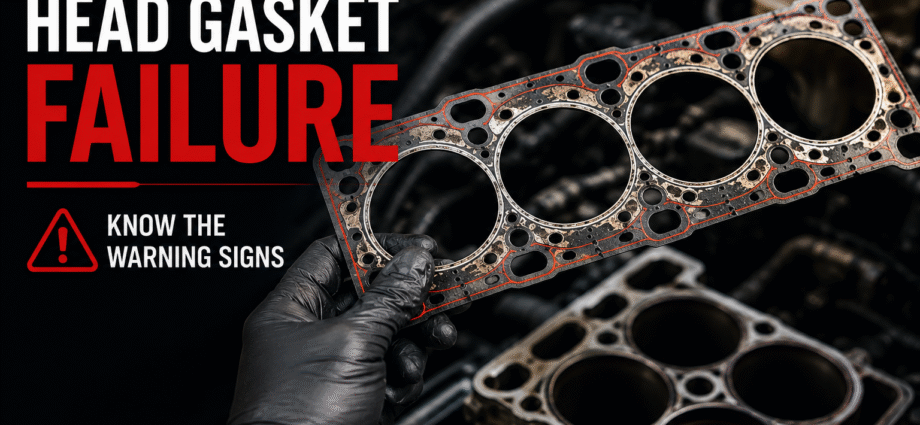
Learn the key warning signs of head gasket failure, from white smoke to overheating, before a small issue becomes a major repair.
Few faults carry the same weight in a driver’s mind as the words head gasket. It has a reputation, and for good reason, since it sits at the centre of one of the more involved and costly engine repairs a car can need. Yet like most serious faults, it rarely appears without warning.
Understanding what a head gasket actually does, and recognising the signs of it beginning to fail, gives drivers a genuine chance to catch the problem early. Regular car servicing can also help identify cooling-system and engine issues before they develop into serious failures. In many cases, the difference between a moderate repair and a full engine rebuild comes down to how quickly these warning signs are noticed and acted on.
What a Head Gasket Actually Does
The head gasket sits between the engine block and the cylinder head, sealing the two together. Its job sounds simple, but it is doing several things at once, keeping coolant and oil separate from each other, sealing the combustion chambers, and maintaining consistent pressure within the engine.
Because it sits at the meeting point of so many critical systems, a failure here rarely stays contained. A compromised seal can allow coolant to enter the combustion chamber, oil to mix with coolant, or compression to leak between cylinders, each of which produces its own distinct set of symptoms.
What Causes a Head Gasket to Fail
Head gaskets do not typically fail out of nowhere. In most cases, the failure is the end result of another issue that was left unresolved for some time.
Common causes include:
- Prolonged engine overheating, often from a coolant leak that went unnoticed
- Age-related wear, particularly in higher-mileage engines
- A poorly fitted gasket from a previous repair
- Detonation or pre-ignition caused by an unrelated engine fault
- Consistently low coolant levels over an extended period
Recognising these root causes matters, since addressing the underlying issue, such as a coolant leak, often prevents a head gasket failure from happening in the first place.
The Warning Signs to Watch For
Head gasket failure tends to develop gradually before reaching a critical point, giving drivers a genuine window to catch it early if they know what to look for.
White Smoke From the Exhaust
Persistent white smoke, particularly smoke that continues well beyond a cold start, is one of the clearest signs of coolant entering the combustion chamber. This should never be mistaken for normal condensation, which typically clears within a minute or two of driving.
Overheating That Happens More Frequently
An engine that overheats repeatedly, especially without an obvious external leak, often points toward a head gasket allowing pressure or fluid to escape internally. This differs from a simple coolant leak, since the fluid is not necessarily visible underneath the car.
Milky or Discoloured Oil
Checking the oil dipstick and finding a pale, milky, almost frothy residue is a strong indicator that coolant has mixed with the engine oil. This is one of the more definitive signs of head gasket failure and should be treated as urgent.
Bubbling in the Coolant Reservoir
If bubbles appear in the coolant reservoir while the engine is running, particularly without the engine actually overheating, this can indicate combustion gases leaking into the cooling system through a failing gasket.
Loss of Engine Power
A noticeable drop in performance, particularly a loss of compression felt as sluggish acceleration, can result from a head gasket failing to seal the combustion chambers correctly.
A Sweet Smell From the Engine Bay
A distinct, sweet smell, similar to that of coolant, but noticeable from inside the cabin or engine bay without an obvious leak underneath the car, often points toward internal coolant loss.
Coolant Disappearing With No Visible Leak
Perhaps the most telling sign of all is a coolant level that keeps dropping steadily, despite no puddles, stains, or visible leaks anywhere underneath the vehicle. When coolant has nowhere obvious to go, it is often because it is being consumed internally within the engine itself.
A Quick Reference Table
| Warning sign | What it usually indicates | Level of urgency |
| White exhaust smoke | Coolant entering combustion chamber | High |
| Milky oil on dipstick | Coolant mixing with engine oil | High |
| Repeated overheating | Internal pressure or fluid loss | High |
| Bubbling coolant reservoir | Combustion gases entering cooling system | Moderate to high |
| Sweet smell with no visible leak | Internal coolant loss | Moderate |
| Coolant disappearing, no puddle | Internal consumption of coolant | Moderate to high |
Why Identifying the Problem Early Can Prevent Serious Damage
Catching head gasket failure in its early stages, before the engine has overheated severely or the cylinder head has warped, often means the difference between a gasket replacement and a full engine rebuild. Once overheating becomes severe enough to warp metal components, the repair scope expands considerably, since machining or replacing the cylinder head becomes necessary alongside the gasket itself.
This is why any single symptom from the list above deserves attention on its own, rather than waiting for several to appear together. By the time multiple signs are present at once, the underlying damage has often already progressed significantly.
How This Fault Gets Diagnosed
A suspected head gasket failure is usually confirmed through a combination of checks rather than a single test alone.
- A visual inspection of the oil and coolant for signs of cross-contamination
- A pressure test on the cooling system to check for internal leaks
- A chemical test on the coolant, which can detect combustion gases present within it
- In some cases, a compression test across cylinders to identify uneven readings
Because several of these symptoms overlap with other cooling system faults, an accurate diagnosis matters considerably before committing to a repair. Drivers looking for general vehicle maintenance and repair support can also find more information from GForce Tyres.
Why Routine Checks Catch This Early
Many of the earliest indicators of a developing head gasket issue- a slightly low coolant level, a faint smell, a temperature gauge running marginally higher than usual- are exactly the kind of details a trained eye notices during routine car servicing. These small observations, easy for a driver to miss day-to-day, are often flagged well before smoke, milky oil, or serious overheating ever develop.
Some cooling-system-related faults can affect MOT results where they create a relevant roadworthiness or emissions issue, but an MOT is not a substitute for routine servicing or an engine inspection.
Why a Full Vehicle Check Matters, Not Just the Engine
It is worth remembering that engine-related faults rarely exist in isolation from the rest of the car, and a genuinely thorough inspection looks well beyond the engine bay alone. Tyre condition, for instance, is checked closely during a comprehensive service, and issues such as a persistent TPMS warning light are worth investigating with the same seriousness as an engine-related symptom, since ignoring smaller warnings often reflects a broader pattern of overlooking early signs across the whole vehicle.
The same principle applies to routine work like tyre fitting. Understanding what happens during a professional tyre fitting highlights just how much attention goes into even the most routine appointments, checks that often reveal small issues elsewhere on the car long before they become serious. A driver who takes tyre warnings seriously tends to take engine warnings seriously too, and that mindset is exactly what prevents a head gasket fault from progressing unnoticed.
What Happens If a Failing Head Gasket Is Ignored
Left unresolved, the progression tends to follow a fairly predictable pattern. Coolant continues mixing with oil or entering the combustion chamber, gradually reducing the engine’s ability to lubricate and cool itself effectively. Overheating episodes become more frequent and more severe, eventually risking damage to the cylinder head itself through warping.
At this final stage, the repair is no longer a straightforward gasket replacement. It becomes a significantly larger job involving machining, additional parts, and considerably more labour, sometimes reaching the point where replacing the engine entirely becomes the more practical option compared to attempting a full repair.
The Emotional and Financial Weight of This Fault
There is a reason head gasket failure carries more weight in conversation than most other car problems. Unlike a worn brake pad or a flat tyre, which feel like routine maintenance, this fault touches the very core of the engine, and drivers often sense that instinctively even before understanding the mechanics behind it.
This reputation is not undeserved. Because the head gasket sits at the intersection of cooling, lubrication, and combustion, a failure here rarely stays contained to one small area. It has the potential to affect the oil system, the cooling system, and engine performance simultaneously, which is part of why repairs in this area tend to involve more labour and more components than most other engine work.
Understanding this helps explain why the warning signs covered earlier deserve more urgency than a typical dashboard light or minor noise. A driver who notices a faint sweet smell or a slightly higher temperature gauge reading is not being overly cautious by having it checked promptly; they are recognising a fault that historically escalates faster and further than most others once it takes hold. Treating early symptoms with genuine seriousness, rather than a wait-and-see approach, is one of the most effective ways to keep this particular fault from living up to its reputation.
Head Gasket Failure Versus Other Cooling System Faults
One of the more common sources of confusion is distinguishing head gasket failure from other, less serious cooling system issues that share some overlapping symptoms. Getting this distinction right matters, since the two are treated very differently in terms of both urgency and repair scope.
A simple coolant leak, for example, from a worn hose or a loose clip, typically shows a visible external trace, a puddle or stain underneath the car, and coolant levels that drop at a fairly predictable rate. Head gasket-related coolant loss behaves differently. It often disappears without any visible external sign, since the fluid is being consumed internally rather than leaking outward.
Similarly, a failing water pump can cause overheating and coolant circulation issues that mimic some head gasket symptoms, but this typically comes with additional clues, such as a whining noise from the front of the engine or visible leakage directly from the pump housing itself.
A few distinguishing points worth keeping in mind:
- External leaks usually leave visible evidence; internal ones often do not
- A failing water pump tends to introduce noise, whereas head gasket issues typically do not
- Milky oil is almost exclusively associated with head gasket failure, rarely with a simple hose or pump fault
- Overheating from a straightforward leak tends to correct itself once coolant is topped up, whereas head gasket-related overheating tends to recur regardless of topping up.
Recognising these differences is not about self-diagnosing with complete certainty, but about arriving at a garage with a clearer, more informed picture. This often speeds up the diagnostic process considerably, since a mechanic working from a well-observed pattern of symptoms can narrow down the likely cause far faster than starting from scratch.
Final Thoughts
A failing head gasket rarely announces itself with a single, unmistakable sign. It tends to speak quietly at first, a faint smell, a coolant level that drops just a little more than expected, an engine that runs slightly warmer on a longer drive. Each of these, taken alone, might seem too minor to act on immediately, yet together they form a pattern well worth paying attention to.
For drivers across Aldershot, Farnborough, Fleet, Farnham, Ash Vale, Tongham, and North Camp, the real value in knowing these warning signs is not fear, but confidence. A driver who recognises white smoke, milky oil, or unexplained coolant loss for what they are has a genuine opportunity to catch the problem while it remains a manageable, affordable repair. Left unnoticed, the same fault only grows more serious, more expensive, and considerably more disruptive. Listening early and acting without delay is what keeps a head gasket issue from ever becoming the engine’s final chapter.
Frequently Asked Questions
Can a car still be driven with early signs of head gasket failure?
It depends on severity. Mild symptoms, such as a faint smell or slightly low coolant, may allow a short drive to a garage, but overheating or milky oil should be treated as a reason to stop driving and seek an inspection promptly.
Is head gasket failure always caused by overheating?
Overheating is the most common cause, but age-related wear, a poor previous repair, or engine detonation can also contribute to gasket failure without a single dramatic overheating event.
How can I tell the difference between a coolant leak and a head gasket issue?
A visible leak with a puddle underneath the car usually points to an external leak, such as a hose or seal. Coolant disappearing with no visible trace often suggests it is being consumed internally, which points more strongly toward the head gasket.
Does white exhaust smoke always mean head gasket failure?
Not always; brief white smoke on a cold start is often just condensation. Persistent smoke that continues once the engine has warmed up is far more likely to indicate a genuine issue.
How much does ignoring the early signs typically increase the eventual repair cost? While costs vary by vehicle, catching the issue early generally keeps the repair to a gasket replacement, whereas prolonged overheating often adds cylinder head machining or replacement, significantly increasing both cost and labour.
READ MORE: clocktimes