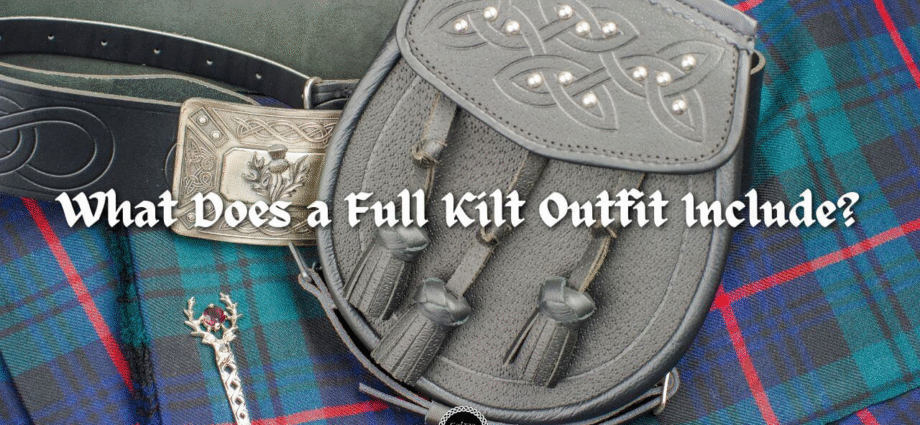
A kilt on its own is half an outfit. What separates the man who looks born to Highland dress from the one who looks like he’s returning a rental is everything else — the jacket, the sporran, the hose, the small hardware most people can’t even name. None of it is complicated, but all of it has a logic.
This is the full anatomy of a kilt outfit, piece by piece, plus how to assemble the right version for each dress code.
The jacket sets the formality
Nothing signals the register of a kilt outfit faster than what’s on your shoulders.
Prince Charlie jacket — short, black barathea wool, satin lapels, silver buttons, worn with a matching waistcoat and bow tie. This is the black-tie tier: evening weddings, formal dinners, awards nights. It’s cropped high specifically so the kilt and sporran show properly.
Argyll jacket — slightly longer, gauntlet cuffs, works with a necktie or bow tie, with or without a waistcoat. The most versatile jacket in Highland dress: correct at daytime weddings, church, graduations, and dinners that stop short of black tie.
Tweed jacket — the daywear option, usually in lovat green, brown, or grey herringbone. Perfect for autumn weddings, races, and country events. Tweed with a tartan kilt is arguably the best-looking combination in the entire tradition.
Waistcoat alone or ghillie shirt — for ceilidhs, casual summer weddings, and festivals. The ghillie shirt (laced open collar, billowed sleeves) is the most relaxed the tradition gets while still reading as Highland dress.
The sporran does the work
With no pockets on a kilt, the sporran is wallet, phone case, and centrepiece in one. It hangs on a chain strap centred on the front apron, and its style must match the jacket’s formality:
- Dress sporran — silver cantle (the metal top), fur face, tassels. Pairs with the Prince Charlie. Wearing one with a tweed jacket is the Highland equivalent of patent shoes with jeans.
- Semi-dress sporran — leather body, modest fur or embossed front. The middle ground; correct with an Argyll.
- Day sporran — plain brown or black leather, simple flap. Belongs with tweed and casual wear.
One rule: the sporran sits about a hand’s width below the belt buckle, centred. Too high looks nervous, too low gets in your way at dinner.
Below the knee
Kilt hose are thick knee socks, worn folded down two or three fingers’ width below the kneecap. Cream is the safe universal; charcoal, lovat, and black read more modern. White hose is traditionally reserved for formal evening and pipe bands.
Flashes — the small coloured fabric tabs peeking from the fold — attach to elastic garters that hold the hose up. Match them to a colour in your tartan and the whole outfit ties together.
Ghillie brogues are the classic footwear: long laces wrapped around the ankle and tied at the front, no tongue. For formal events they’re standard. For daywear, plain black or brown brogues are completely acceptable, and frankly more comfortable.
The small hardware
- Kilt pin — worn low on the open corner of the front apron, purely decorative, pinned through the top layer only (never pin the aprons together; it ruins the swing).
- Sgian dubh — the small ceremonial knife tucked into the hose top, handle showing, on your dominant side. Skip it for flights and venues with security screening; no one will hold it against you.
- Belt and buckle — a wide leather kilt belt with a substantial buckle, worn when there’s no waistcoat. Under a waistcoat, tradition drops the belt entirely.
Assembling by dress code
Black tie / evening wedding: Prince Charlie + waistcoat, wing-collar shirt, black bow tie, dress sporran, cream or white hose, ghillie brogues, sgian dubh.
Daytime wedding / graduation: Argyll jacket, standard collar shirt, necktie, semi-dress sporran, cream hose, brogues.
Country / autumn event: tweed jacket, tattersall or plain shirt, wool tie optional, day sporran, lovat hose, brown brogues.
Ceilidh / casual: ghillie shirt or open collar, waistcoat optional, day sporran or none, dark hose, any brogues or boots. Comfort wins — you’ll be dancing.
If you’re starting from zero, the maths favours the package route: complete kilt outfits bundle the kilt, jacket, sporran, hose, flashes, belt, and pin in matched formality, which costs meaningfully less than assembling the pieces one by one and removes every mix-and-match mistake on this page in one decision.
The extras: fly plaid, sash, and headwear
Beyond the core outfit sit the pieces that turn Highland dress up to eleven — used sparingly, they’re spectacular; used together, they’re a parade.
The fly plaid is the dramatic one: a square of matching tartan pleated and pinned at the left shoulder with a large plaid brooch, cascading down the back. It belongs exclusively with the Prince Charlie at full-formal evening events — grooms wear it more than anyone, and on a groom it’s magnificent. On a regular wedding guest it’s borrowing the spotlight; leave it to the man of the day.
The plaid brooch that anchors it is jewellery in its own right — typically a large circular Celtic or thistle design — and worth choosing deliberately if you’re going full fig, because it sits at eye level in every photograph.
Headwear divides into the Balmoral (soft, round, pom on top, worn slightly tilted) and the Glengarry (boat-shaped, ribbons behind). Both carry a clan cap badge well. Outside pipe bands and military contexts they’re optional and increasingly rare at weddings — but at Highland games and Burns suppers they finish the look properly.
The kilt fly or under-apron matters not at all — but the plaid to match your kilt question does: if you’re commissioning a kilt for a wedding, order the fly plaid from the same bolt at the same time. Dye lots vary, and a plaid woven later can sit visibly off-shade against the kilt in daylight.
Budgeting the outfit — and the order to buy it
A complete formal outfit divides into three spending tiers, and knowing them stops both overspending and false economy.
The kilt takes half the budget. It’s the piece with the longest life and the highest craft content; economising here shows from across the room, while a good one outlasts every jacket you’ll ever pair with it.
The jacket and sporran split the next third. These two set the formality register, and mismatching their tier to the kilt’s quality is the most common assembled-outfit error — a fine wool kilt under a shiny costume jacket reads as fancy dress.
Hose, flashes, belt, brogues, and pin share the remainder. Cheap hose sag by dinner; decent wool-blend hose are one of the best small upgrades in the whole ensemble.
Bought separately at mid-range quality, the full formal rig adds up quickly — which is exactly why the package route exists. A bundled outfit from a specialist such as Scottish Kilt Shop coordinates kilt, jacket, waistcoat, sporran, hose, flashes, belt, and pin in one matched formality tier, typically at a meaningful saving over piecemeal buying — and, just as valuably, it removes every register-mismatch mistake this guide warns about in a single decision.
Rent or buy? The maths is simple: one formal event, rent; two or more on the horizon, buy. Rental fees reach purchase price by the second or third outing, and owned kilts get worn far more than their buyers predict — the calendar finds occasions once the wardrobe contains one.
Grooms and wedding parties: coordinating without cloning
Weddings generate most first kilt outfits, so the coordination question deserves an answer. The classic structure: the groom distinguishes himself by degree, not difference — he takes the fly plaid, the dressier sporran, or a waistcoat in a contrasting tone, while groomsmen wear the same tartan one notch simpler. Identical outfits head to toe read as a uniform; the graduated version photographs as a party with a clear centre.
Mixed-heritage parties have two good options: everyone in the couple’s chosen sett regardless of their own clans (unity), or each man in his own tartan with matching jackets and accessories (heritage). Both are traditional; the second is livelier in photographs and gives every guest a conversation piece.
Book early — made-to-measure kilts want six to ten weeks, and wedding season compresses every workshop’s calendar. And insist the whole party’s cloth comes from the same order: the same tartan from different dye lots can shift noticeably on camera, which is exactly the kind of detail nobody notices until the album arrives.
Three errors to avoid
- Formality mismatch — a dress sporran with tweed, or trainers with a Prince Charlie. Every piece should sit in the same register.
- The low-slung kilt — worn at the hips like jeans, the hem drops past the knee and the proportions die. Natural waist, always.
- Over-accessorising — pin, sgian dubh, fly plaid, clan badge, and cape at a daytime event is fancy dress. Pick the pieces the occasion earns.
Get the register right and the rest is presence. A properly assembled kilt outfit doesn’t just hold its own next to a room full of suits — it makes the suits look like they didn’t try.
READ MORE: clocktimes