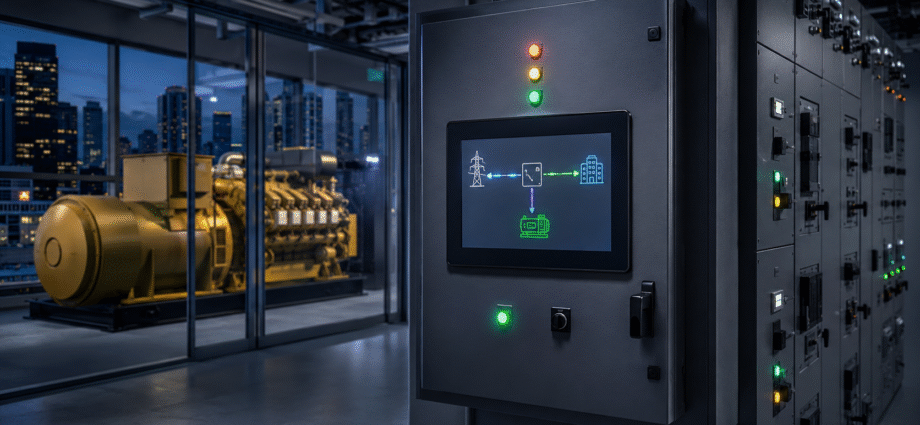
Power cuts can disrupt business operations, damage sensitive equipment, and create serious safety risks. An auto mains failure system provides a practical solution by detecting problems with the utility supply and automatically starting a standby generator. It restores electricity without waiting for a technician to operate a manual switch. This technology is widely used in hospitals, factories, offices, hotels, data centers, shopping centers, and other facilities where uninterrupted power is important. The system does more than respond to a complete blackout. A properly configured AMF panel can also detect low voltage, high voltage, incorrect frequency, and phase failure. By monitoring the electrical supply continuously, it helps maintain a dependable source of power during unexpected grid problems.
What Is Auto Mains Failure?
Auto mains failure, commonly shortened to AMF, is an automated control process used with a standby generator. Its main purpose is to monitor the incoming utility power and respond when that supply becomes unavailable or unsafe. When the controller identifies a fault, it sends a signal to start the generator. After the generator reaches a stable voltage and frequency, the system transfers the connected electrical load from the mains to the backup source. When normal utility power returns, the system reverses the process, transfers the load back, and eventually stops the generator. This complete sequence takes place automatically, although authorized operators can normally use manual controls for maintenance and testing.
What Is an AMF Panel?
An AMF panel is the central control unit responsible for managing the backup-power sequence. It contains monitoring equipment, relays, protective devices, switches, indicators, and a programmable controller. These components work together to measure the condition of the utility power and communicate with the generator. The panel may display information such as voltage, current, frequency, generator running hours, battery condition, and alarm messages. Advanced models can also monitor engine temperature, fuel level, oil pressure, and emergency shutdown signals. Although people sometimes describe the panel as a simple switch, it performs several important control and safety functions. Its design must match the generator rating, electrical load, supply arrangement, and requirements of the building.
How an Auto Mains Failure System Works
The AMF process begins with continuous monitoring. While the grid is operating normally, the facility receives electricity from the utility supply, and the standby generator remains stopped. The controller measures electrical values and compares them with programmed limits. If the mains supply disappears or moves outside safe limits, the panel waits for a short confirmation delay. This delay prevents unnecessary generator starts caused by very brief voltage changes. Once the failure is confirmed, the system isolates the mains connection and sends a start command to the generator.
The generator then begins running and builds up its operating speed. The controller checks whether its output voltage and frequency are stable before connecting it to the facility. After those conditions are satisfied, the transfer equipment moves the load to generator power. The time needed for this process varies according to the panel settings, generator, and installation. During this short delay, equipment will normally lose power unless the facility also uses a UPS system or another temporary energy source.
What Happens When Utility Power Returns?
An AMF system continues checking the grid even while the generator is supplying electricity. When utility power returns, the controller does not always transfer the load immediately. It usually waits through a mains restoration delay to confirm that the supply is stable. This helps prevent repeated switching if the grid returns briefly and fails again. Once the power remains within the accepted limits, the transfer mechanism reconnects the facility to the mains.
The generator is generally allowed to continue running without carrying the main load for a short period. This stage is known as the cool-down cycle. It allows internal temperatures to settle before the engine stops. After cooling, the controller shuts down the generator and returns it to standby mode. The entire system then continues monitoring the mains, ready to respond to another failure.
Important Components of an AMF System
The controller is one of the most important parts of the system because it interprets electrical conditions and manages the operating sequence. Voltage and frequency sensors provide the information needed to identify a power failure. Contactors, motorized changeover switches, or circuit breakers physically connect the load to the selected power source. Electrical and mechanical interlocks prevent the mains and generator from being connected together accidentally in systems that are not designed for synchronization.
Other components may include a generator battery charger, control relays, warning lights, emergency-stop controls, protective fuses, and circuit breakers. Some panels have communication ports that allow technicians to check status information remotely. Larger installations may include fuel monitoring, building-management-system connections, and alarms that notify staff about failed starts or abnormal engine conditions. Every component should be selected according to the expected current, fault level, environmental conditions, and local electrical requirements.
Auto Mains Failure vs Automatic Transfer Switch
The terms AMF and automatic transfer switch, or ATS, are often used together, but they do not always describe exactly the same function. An AMF controller focuses on detecting the condition of the mains and managing the generator’s start and stop sequence. An ATS focuses primarily on transferring the electrical load between two available power sources. In many modern installations, these functions are combined inside one coordinated panel, which is why the terms are sometimes used interchangeably.
The exact arrangement depends on the equipment and system design. A small commercial property may use a single panel containing both the AMF controller and transfer contactors. A larger facility may have separate generator controls, switchgear, protective relays, and transfer equipment. Buyers should check the technical specification instead of relying only on the product name.
Main Benefits of Auto Mains Failure
The greatest benefit of an auto mains failure system is automatic power restoration. Staff do not need to locate a generator, start it manually, and operate a changeover switch during an outage. This reduces delays and ensures a more consistent response, even when a building is empty. It also lowers the risk of mistakes caused by rushed manual switching.
AMF systems can protect essential operations by responding to poor-quality utility power as well as complete outages. They may detect missing phases, abnormal frequency, and voltage outside programmed limits. The panel also provides useful operating data and alerts, helping maintenance teams identify problems. For businesses, this support can reduce downtime, protect temperature-controlled stock, maintain security systems, and keep important machinery available.
Where AMF Systems Are Used
Hospitals use backup-power systems to support medical areas, lighting, communication equipment, and other essential services, although their designs often include additional redundancy. Data centers rely on coordinated generators and UPS units to keep servers operating. Factories use AMF systems to reduce production interruptions and support controlled equipment shutdowns. Hotels, offices, supermarkets, warehouses, schools, apartment buildings, telecom sites, and farms may also install them.
The system must be designed around essential loads, not simply the total size of the property. Some installations power an entire building, while others supply only emergency lighting, security equipment, refrigeration, pumps, or critical machinery. A qualified engineer calculates the expected load, motor-starting current, generator capacity, and transfer arrangement.
Maintenance and Regular Testing
Automatic operation does not remove the need for maintenance. A neglected generator may fail to start even if the AMF panel works correctly. The generator battery, fuel supply, oil level, cooling system, electrical connections, and alarms require scheduled inspection. Dust, moisture, loose terminals, damaged wiring, and weak batteries can all affect reliability.
Facilities should conduct planned tests that simulate a mains failure and confirm the full operating sequence. Testing should verify generator starting, voltage stability, load transfer, mains restoration, cool-down, and shutdown. Maintenance personnel should record faults, running hours, and service work. Any changes to the building’s electrical load should also be reviewed because the original generator may no longer have sufficient capacity.
Safety and Installation Considerations
AMF equipment handles potentially dangerous voltage and high fault currents, so installation should be completed by qualified electrical professionals. Incorrect wiring can damage the generator, create electric-shock hazards, or feed electricity back into the utility network. Proper earthing, circuit protection, cable sizing, ventilation, fuel storage, and emergency isolation are essential. The panel must be properly protected from dust, moisture, high temperatures, and unauthorised handling.
Conclusion
An auto mains failure system reliably controls backup power whenever the main electricity supply is interrupted. It monitors the mains, starts the generator, checks its output, transfers the electrical load, and returns the facility to grid power when conditions become stable. Its automatic response can reduce downtime, protect essential operations, and remove the delay of manual generator control. However, reliable performance depends on correct design, professional installation, regular testing, and generator maintenance. A well-chosen AMF system plays a key role in maintaining continuous power throughout a facility.
Frequently Asked Questions
What does auto mains failure mean?
It describes an automated system that detects an unavailable or unsafe utility supply and starts a standby generator to restore power.
How quickly does an AMF system restore electricity?
The time varies according to programmed delays and generator performance. It commonly takes several seconds for the generator to start, stabilize, and accept the load.
Does an AMF panel work like a UPS?
No. A UPS can provide near-instant temporary power, while an AMF panel manages generator startup and source transfer. Many critical facilities use both systems together.
Can an AMF system detect low voltage?
Yes. Depending on its configuration, it may detect low voltage, high voltage, phase failure, incorrect frequency, and a complete loss of mains power.
Does an AMF generator require maintenance?
Yes. The generator, battery, fuel system, controller, transfer equipment, and protective devices require regular inspection and testing to remain reliable.
READ MORE: clocktimes