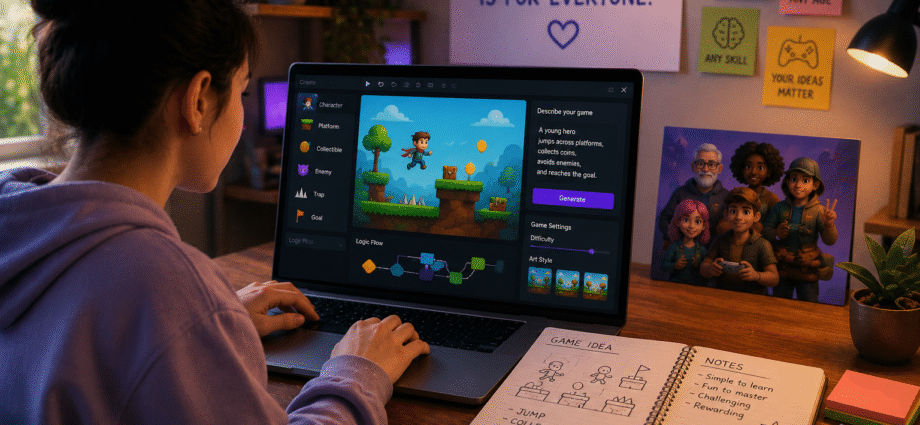
Access has always been the quiet limiting factor in who gets to make games. Not talent, not creativity, not even good ideas; those have always existed in abundance across every kind of person imaginable. What limited who actually built games was access to the technical skill required to execute an idea. AI-powered game creation is breaking down long-standing barriers, transforming game development into a space where far more people can build, create, and innovate.
The Access Problem Nobody Talked About Enough
For decades, having a genuinely good game idea meant very little if you couldn’t code, couldn’t afford to hire someone who could, or didn’t have the time to spend years learning a skill that had nothing to do with the creative instinct that produced the idea in the first place. This wasn’t a talent gap. It was an access gap, and it quietly filtered out an enormous amount of creative potential simply because the people who had it didn’t also happen to have programming backgrounds.
Traditional development tools didn’t intend to be exclusionary, but the practical effect was the same regardless of intent. Learning curves measured in months or years meant that only people with significant free time, financial stability, or existing technical inclination could realistically pursue game development as a serious creative outlet. Everyone else’s ideas simply stayed ideas.
What Changed With AI Game Makers
Removing the Technical Prerequisite Entirely
The fundamental shift AI game makers introduced isn’t speed for its own sake; it’s the removal of a prerequisite that used to gate entry into the field. You no longer need to learn a programming language before testing whether you can build something playable. You describe your idea, and the platform handles the technical translation. That single change collapses a barrier that used to take years to clear.
Making the First Attempt Low-Risk
When building even a rough prototype required weeks of learning and implementation, trying game development felt like a serious commitment before you even knew if you’d enjoy it. AI game makers let someone test their interest within a single afternoon. That low-risk first attempt matters enormously for accessibility, since it means people who might have been curious but never committed now have almost nothing stopping them from finding out.
Democratizing Iteration, Not Just Creation
Accessibility isn’t only about the first step; it’s about whether someone can keep improving what they’ve built. Traditional development made iteration expensive, which meant only people with significant technical skill could refine an idea through many rounds of testing. AI-assisted tools make that iterative process available to anyone, regardless of technical background, which means the quality ceiling for accessible development keeps rising rather than staying capped at “simple but functional.”
Who This Is Actually Reaching
People Outside the Traditional Tech Pipeline
Historically, game development skewed heavily toward people who came up through computer science education or self-taught programming, often starting young and with access to computers and free time that not everyone had. AI game makers open the field to people who took entirely different paths: teachers, nurses, retail workers, retirees, anyone with a genuine idea and no traditional technical background whatsoever.
Creators in Regions With Limited Technical Education Access
Formal programming education isn’t evenly distributed globally. AI-assisted, plain-language development tools reduce the dependency on that specific kind of education, letting creators anywhere with an internet connection and a good idea participate in game development regardless of their local access to computer science instruction.
People With Disabilities That Made Traditional Coding Difficult
For some people, the physical or cognitive demands of traditional coding- precise syntax, extensive screen time, complex debugging- presented barriers beyond just time investment. Natural language interfaces remove some of those specific friction points, opening a path that wasn’t previously realistic for everyone.
Older Creators Picking Up Something New
Learning to code from scratch later in life is a genuinely difficult undertaking, one that discourages plenty of people who might otherwise have real creative ideas worth building. Describing a concept in plain language doesn’t carry the same steep learning curve, making game development newly accessible to people who assumed that door had closed for them.
Real Examples of What Accessible Development Produces
It’s worth being honest that accessibility sometimes gets used as a euphemism for “simpler” or “lesser,” implying that accessible tools necessarily produce diminished results. That assumption doesn’t hold up against what’s actually being built. Games like Astro Spideeey demonstrate that accessible, AI-assisted development can produce something genuinely well-tuned and satisfying, not a simplified stand-in for what “real” development would have achieved. The accessibility of the tool and the quality of the output aren’t in tension with each other the way they used to be.
No-code game maker platforms have made this kind of result increasingly common rather than exceptional, precisely because removing the technical barrier frees creators to spend their limited time and attention on the design decisions that actually determine quality, pacing, feel, fairness, rather than on debugging syntax errors that have nothing to do with whether a game is fun.
What Accessibility Doesn’t Remove
The Need for Genuine Creative Judgment
Making development accessible doesn’t mean every resulting game is automatically good. The tool executes what’s described; it doesn’t supply the underlying creative instinct that makes an idea worth pursuing in the first place. That judgment still has to come from the person building the game, accessible tools or not.
The Value of Honest Playtesting
Accessibility lowers the barrier to creating, not the requirement to test honestly and refine based on real feedback. A first-time creator using an accessible tool still needs to watch real players interact with their game and adjust accordingly, exactly as any developer always has.
The Importance of Design Understanding Over Time
While the technical barrier has dropped, developing a genuine sense of what makes games good still takes time and attention: playing critically, noticing what works in other games, and reflecting on what made one version of your project stand out over the others. Accessible tools remove one obstacle, not the entire learning process.
Why This Shift Matters Beyond Individual Creators
More Diverse Perspectives Entering the Field
When technical skill stops being the primary filter for who gets to build games, the range of perspectives, backgrounds, and creative instincts entering the field naturally broadens. That diversity tends to produce a wider range of ideas and approaches than a field filtered primarily by who happened to learn programming young.
Smaller, Independent Voices Getting Real Reach
Accessible development tools mean a single person with a genuinely good idea and no studio backing them can produce something that reaches players directly, without needing to convince a larger organisation to invest in the concept first. That directness matters for creative diversity in a way that’s easy to underestimate.
The Definition of “Developer” Genuinely Broadening
Someone with no programming background who builds and ships a satisfying, well-received game deserves the title of developer just as much as someone who spent years learning to code. That broadening definition reflects a real and lasting shift in who’s capable of bringing an idea to life, not a temporary trend that will reverse once the novelty fades.
Final Thoughts
AI game makers are making game development accessible not by lowering standards for what counts as a good game, but by removing a barrier that never actually measured creative potential in the first place: technical skill. The people who always had good instincts for what makes a game fun now have a direct path to acting on those instincts, regardless of their background, education, location, or how much free time they have to dedicate to learning a technical craft that was never really the point.
What gets built as a result of that accessibility is still shaped entirely by human judgment, creativity, and the willingness to iterate based on real feedback. The tools just made sure that judgment finally gets a fair chance to matter, for a much wider range of people than it ever did before.
READ MORE: clocktimes