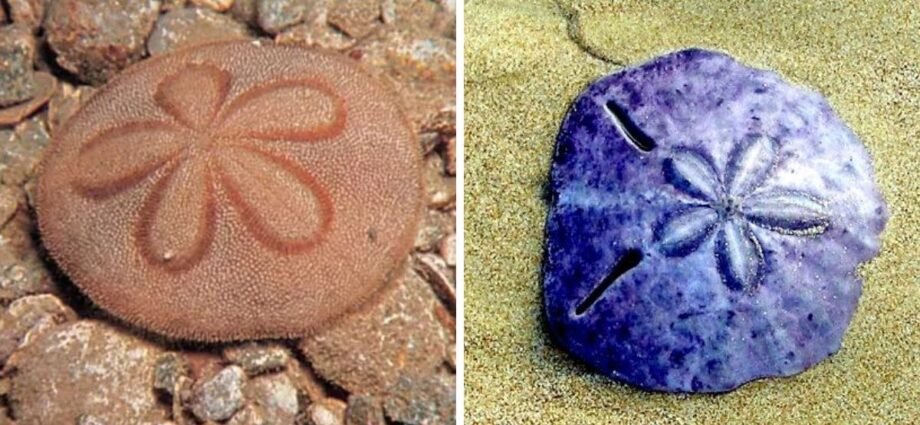
A sand dollar is one of the ocean’s most fascinating and often misunderstood marine animals, commonly recognised as the smooth white discs found on beaches. Many people wonder what this creature really is and even question “who is it or she?” In reality, the sand dollar is a living echinoderm closely related to sea urchins and starfish. While the bleached shell found on shore is actually its skeleton, known as a test, the living animal is active, sensitive, and adapted to life beneath the sand. Hidden just below shallow seabeds, it plays an important ecological role in coastal ecosystems. Understanding the sand dollar reveals how complex and specialised marine life can be, even in creatures that appear simple at first glance.
What is a Sand Dollar?
The sand dollar is a flattened marine echinoderm belonging to the same group as sea urchins, starfish, and sea cucumbers. Scientifically adapted for life in sandy environments, it belongs to the order Clypeasteroida. Unlike its spiny relatives, it has evolved a disk-shaped body that allows it to burrow efficiently under sediment. Living sand dollars are covered with tiny spines and microscopic hair-like structures called cilia, which help with movement and feeding. The familiar white object found on beaches is not the living animal but its hardened test, formed from calcium carbonate plates. This skeleton often displays a symmetrical flower-like pattern, reflecting the animal’s internal structure and respiratory system.
Anatomy and Structure
The anatomy of a sand dollar is uniquely designed for survival under shifting sand. Its body is covered with thousands of microscopic spines that work alongside tube feet to help it move, burrow, and collect food particles. On its upper surface, the five-petal design is made up of pores that allow gas exchange and the extension of tube feet for respiration. Internally, it has a specialised feeding structure known as Aristotle’s lantern, a jaw-like mechanism with five teeth used to break down organic matter. The rigid test protects while maintaining flexibility for growth. Despite its simple appearance, the sand dollar has an efficient internal system that supports life in low-oxygen, sediment-heavy environments where few animals can survive.
Habitat and Distribution
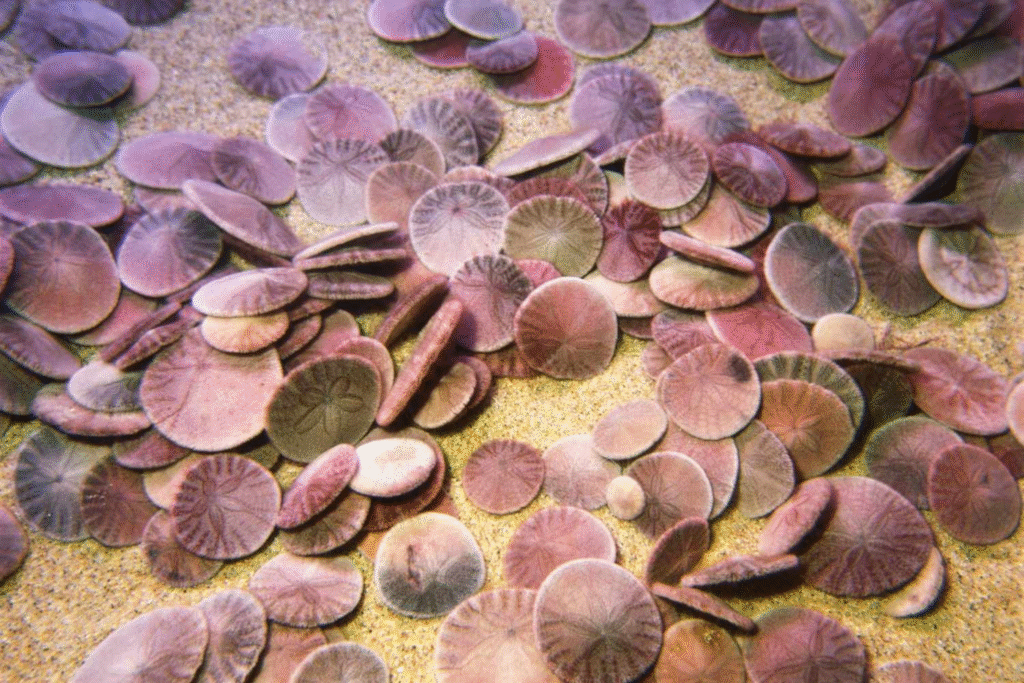
Sand dollars are found in shallow coastal waters around the world, especially in temperate and tropical regions. They prefer sandy or fine sediment seabeds where they can easily bury themselves for protection and feeding. The sand dollar typically lives just beneath the surface of the sand, allowing ocean currents to deliver food directly over its body. In calm waters, it may position itself slightly upright to maximise feeding efficiency, while in stronger currents it buries deeper for stability. Their presence is often associated with healthy marine ecosystems because they require clean, oxygen-rich sandy environments. These habitats support their survival and reproduction while maintaining ecological balance in coastal zones.
Feeding Behavior
The feeding process of a sand dollar is mostly passive and depends on water movement. It consumes microscopic algae, plankton, and organic detritus that drift through the water or settle in the sand. Using its spines and cilia, it directs food particles into grooves on its body that transport nutrients toward the mouth. The mouth contains Aristotle’s lantern, which grinds food into smaller, digestible pieces. Unlike predators, sand dollars rely on continuous sediment flow to deliver nutrients, making them highly adapted to coastal environments. This feeding method also plays a key ecological role by recycling organic matter and maintaining nutrient balance within marine ecosystems.
Life Cycle and Reproduction
The life cycle of a sand dollar begins as microscopic larvae released into the ocean through external fertilisation. These larvae drift with plankton for several weeks before settling onto sandy seabeds. Once they find a suitable habitat, they undergo metamorphosis into juvenile sand dollars, gradually developing their flattened shape and forming the protective test. As they mature, they continue growing by adding calcium carbonate to their skeleton. Sand dollars typically live between six and fifteen years, depending on environmental conditions. Their reproductive cycles are often seasonal, ensuring higher survival rates for offspring in favourable ocean conditions.
How to Identify a Live Sand Dollar
Identifying whether a sand dollar is alive is important for ecological protection. A living sand dollar usually has a dark colour ranging from brown to purple or grey and is covered in soft, velvety spines that may move slightly. In contrast, dead specimens are smooth, rigid, and bleached white due to sun exposure, forming the familiar beach-found test. Some living individuals may release a pigment called echinochrome when stressed, which can create a faint yellow tint, but this is not a reliable test of life. Careful observation is necessary to avoid disturbing living organisms in their natural habitat.
Ecological Importance
The sand dollar plays a vital role in marine ecosystems by contributing to sediment turnover and nutrient cycling. As it feeds on organic matter, it helps recycle nutrients back into the environment, supporting microorganisms and small marine species. Its burrowing activity also aerates the seabed, improving oxygen flow within sediments. Additionally, sand dollars serve as prey for fish, crabs, and sea stars, making them an important link in the coastal food chain. Their sensitivity to environmental changes makes them useful indicators of ecosystem health, reflecting the stability of sandy marine habitats.
FAQs
Q1: What is a sand dollar?
A sand dollar is a flattened marine echinoderm related to sea urchins that lives buried in sandy seabeds and feeds on organic particles.
Q2: How do sand dollars eat?
They use spines and tube feet to move food into their mouth, where Aristotle’s lantern grinds it into digestible material.
Q3: Are white sand dollars alive?
No, white sand dollars are usually dead skeletons called tests that have been bleached by sun and seawater exposure.
Q4: Where do sand dollars live?
They live in shallow sandy coastal waters around the world, especially in areas with gentle currents and stable sediments.
Q5: Why are sand dollars important?
They recycle nutrients, aerate seabeds, and support marine food chains, making them key indicators of healthy marine ecosystems.
Conclusion
The sand dollar is far more than a simple beach souvenir; it is a living marine organism with complex adaptations for survival beneath the sand. From its specialised feeding system to its unique skeletal structure, it plays an essential role in maintaining ecological balance in coastal environments. By understanding its lifecycle, habitat, and behaviour, we gain deeper insight into the hidden world beneath the ocean’s surface. Protecting sand dollars and their habitats helps preserve the health of marine ecosystems and ensures that these remarkable creatures continue to thrive in the oceans.
READ MORE: clocktimes