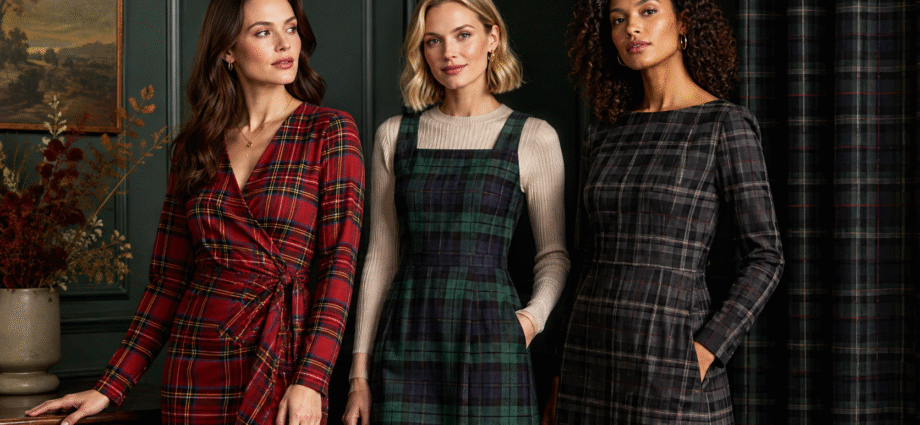
Tartan has a typecasting problem. Say “tartan dress” and most people picture exactly one thing: a red Christmas-party number worn twice a year and stored eleven months in guilt. Which is a waste, because tartan is one of the few patterns that genuinely spans the whole calendar and the entire formality range — office to ceilidh to summer festival — if you match the sett and silhouette to the room.
Here’s the occasion-by-occasion guide.
The holiday party (obviously — but done right)
Yes, tartan owns December; the trick is avoiding the costume version. Skip the crimson-and-green combination worn with everything sparkly, and instead pick one festive element: a Royal Stewart or red-ground dress with plain black tights and matte accessories, or a deep green tartan with gold jewellery as the only shine. Velvet-trimmed collars and cuffs on a tartan dress are the elevated holiday move — festive at a glance, tailored on inspection.
Weddings and ceilidhs
A tartan dress at a Scottish wedding is not just acceptable; it’s participation. For guests, midi-length tartans in blues, greens, or muted heritage setts strike the right note — celebratory without competing with the bridal party. If the couple has a clan tartan, wearing a different sett is the traditionally polite choice unless you share the connection; wearing complementary colours from their tartan is the thoughtful middle path.
For ceilidh dancing specifically, prioritise skirt movement: a fit-and-flare or pleated-skirt tartan dress swings through Strip the Willow the way a bodycon simply cannot. You will thank yourself by the second reel.
The office
This is tartan’s most underused territory. The rules that make it work: smaller-scale sets, darker grounds, and structured silhouettes. A charcoal- or navy-based tartan shift or pinafore dress with a fine turtleneck underneath reads as sharp as any solid — the pattern registers as texture from across a meeting room. Grey-scale tartans are the cheat code here: all the pattern interest, zero colour risk. Browsing a dedicated ladies tartan clothing collection will show how wide the muted, office-viable end of the spectrum actually runs — it’s most of the range, not the exception.
Autumn weekends
The pattern’s natural habitat. Rust, mustard, olive, and brown-ground tartans were built for October: pair a swingy tartan midi dress with knee boots and a chunky cardigan, or layer a tartan pinafore over a cream roll-neck. This is the lowest-effort, highest-reward tartan season — the landscape is doing half your colour coordination.
Summer, genuinely
Tartan doesn’t hibernate. Lightweight cotton and viscose tartans in softer palettes — the “ancient” colourways, with their faded vegetable-dye tones — make excellent summer dresses: think sleeveless shirt-dresses, tiered midis, and square-neck minis in washed-out blues and heathers. Worn with sandals and straw accessories, the pattern reads closer to picnic gingham’s sophisticated cousin than to Highland winter.
Evening
Dark-ground tartan after dark is a quiet power move. A long tartan dress in deep navy-and-green or black-and-red, satin heels, and metallic jewellery holds its own against any solid gown in the room — woven tartan catches low light along its lines and photographs with unusual depth. The Black Stewart and Black Watch families are the setts to hunt for here.
Fit notes that apply everywhere
Match the set scale to the silhouette. Large blanket-scale tartans want simple, unfussy cuts — the pattern is the event. Small setts tolerate ruffles, tiers, and details.
Use the grid. Tartan’s lines telegraph construction quality: check that the pattern aligns at seams and sits level at the hem. A dress that passes that test is well-made everywhere else, too.
Steal the palette. Every tartan has its own colour scheme. Pull tights, shoes, or bag colours from stripes already in the set and the outfit self-coordinates — the great secret of why tartan is easier to accessorise than solids.
Choosing your sett: a colour field guide
The pattern family is enormous, but the wearable landscape breaks into five colour territories — and knowing which one you’re shopping in makes every other decision easier.
Red grounds (Royal Stewart, Wallace, Fraser) are the celebration setts: maximum recognition, maximum festivity, best deployed for the holidays and evening events where you want the room to notice. One red tartan dress is essential; two is a themed wardrobe.
Green and navy grounds (Black Watch, Gordon, Huntingts) are the workhorses — the tartans that read as sophisticated rather than seasonal. Black Watch in particular is the little black dress of the pattern world: dark enough for evening, muted enough for Tuesday, and flattering against nearly every complexion.
Ancient and weathered colourways take any clan’s sett and fade it to soft, vegetable-dye tones — dusty blues, sage, oatmeal. These are the summer and daytime sets, and the answer for anyone who loves tartan but finds the saturated versions loud.
Greyscale and monochrome sets (Grey Stewart, Black Stewart, shadow tartans) are the modern wardrobe’s easiest entry: all pattern, no colour risk, and they pair with everything already hanging in the closet.
Dress tartans — white-ground versions built historically for dancing — photograph beautifully and own the festive-formal lane, with the caveat that white grounds carry every red-wine risk the evening offers.
If a family or district connection exists, start there; most clans weave in several of these territories, so heritage and taste rarely have to fight. No connection? The universal setts — Black Watch, the Stewarts, Caledonia — are open to everyone by long convention.
Fit and fabric details that flatter
Pattern gets the attention, but construction decides whether a tartan dress flatters or fights you.
Bias-cut sections are the secret weapon. When a maker turns the tartan 45 degrees — a bias-cut bodice panel, skirt, or trim against straight-grain elsewhere — the diagonal lines slim and the dress gains movement. It’s the single detail most worth paying for.
Scale to your frame. Petite frames sing in small, tight sets and drown in blanket-scale checks; taller wearers can carry the big bold patterns that overwhelm everyone else. When in doubt, mid-scale sets in the two-to-three-inch repeat flatter the widest range.
Waist definition is non-negotiable. Because tartan’s horizontal lines widen visually, the silhouettes that consistently work — fit-and-flare, wrap, belted shift, pinafore-over-fitted-knit — all break the pattern at the waist. The shapeless tartan sack is how the “Christmas costume” reputation happened.
Fibre follows occasion. Brushed wool blends and flannels for autumn and winter structure; viscose and cotton lawns for the summer sets; a touch of stretch in office shifts for eight-hour wearability. And check the grid at the seams — matched pattern lines at side seams and the zip are the two-second quality test that never lies.
Specialist ranges make all of this dramatically easier to shop, simply because the depth is there: a dedicated tartan house like Scottish Kilt Shop cuts dresses across the whole colour map above — registered clan setts included — rather than offering one red check each November, which is precisely how you find the green-ground office dress and the weathered summer midi the high street never stocks.
Accessorising without the costume
The line between “wearing tartan” and “wearing a costume” is drawn entirely by accessories. Keep hardware matte or minimal when the sett is loud; save the statement jewellery for the muted greys and hunting tartans that can carry it. Solid tights and shoes pulled from the pattern’s darkest stripe ground almost any dress, while a plain leather belt at the waist instantly sharpens shift and shirt-dress silhouettes. The one pairing to avoid is tartan-on-tartan in different setts — it takes a stylist’s eye to survive, and even then, rarely. One pattern per outfit; let everything else serve it.
The three-dress capsule
If tartan earns a real place in the wardrobe, three dresses cover the entire year described above. The dark workhorse: a Black Watch or grey-sett structured shift or pinafore — office, dinners, travel, the dress that makes tartan a Tuesday option. The celebration piece: a red-ground fit-and-flare or velvet-trimmed midi that owns December, weddings, and every party invitation with music attached. The soft-season dress: a lightweight cotton or viscose number in ancient colourways — the faded blues and heathers — for late spring through summer.
Between them, the three hit every occasion on this page while sharing accessories: black opaque tights and boots serve the first two; the same gold jewellery moves across all three; one plain wool coat covers the winter pair. That’s six or more distinct occasion-outfits from three garments — a cost-per-wear ratio the rest of the occasionwear rail can’t touch, and the practical rebuttal to tartan’s twice-a-year reputation.
Build it in that order, too: the dark dress proves how often you’ll actually reach for the pattern; the other two follow the evidence.
The takeaway
One pattern, six occasions, twelve months. The red party dress can stay — but let it be the fifth tartan dress in the wardrobe rather than the only one. The clans wore these patterns daily for centuries; the least we can do is get them out more than twice a year. Start with the occasion already on your calendar, pick the sett that matches the room rather than the season’s clichés, and the rest of the wardrobe will make space on its own.
READ MORE: clocktimes