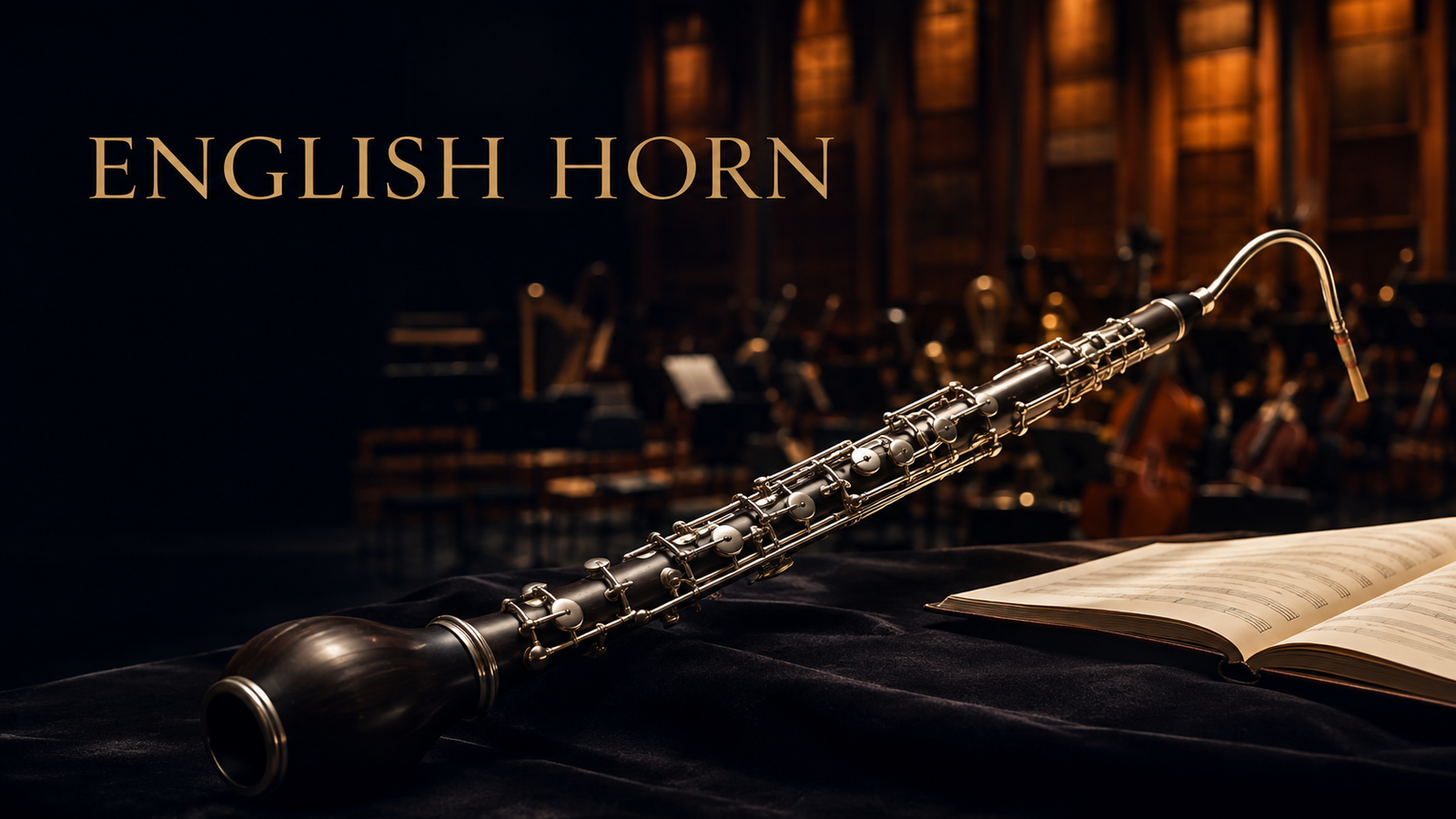
The English horn is a distinctive double-reed woodwind closely related to the oboe. It is larger and lower in pitch than the standard oboe, producing a warm, deep, and expressive tone. Despite its name, it is neither English in origin nor a member of the brass horn family. Musicians in many countries call it the cor anglais, which is its French name. The instrument commonly appears in symphony orchestras, concert bands, film scores, and selected chamber works. Composers often use it for reflective, pastoral, mysterious, or sorrowful melodies because its sound can stand out without becoming harsh. Its long wooden body, curved metal tube, double reed, and pear-shaped bell give it a recognizable appearance. Although it shares many fingerings with the oboe, the English horn has a distinct playing response and musical character.
Why Is It Called an English Horn?
The exact origin of the name has been debated for many years. The instrument was not invented in England, and it does not operate like a French horn or trumpet. One explanation connects the name with an earlier curved or angled form of the instrument. A term describing an angled horn may have been misunderstood or translated over time, eventually becoming “English horn.” Another theory links the name to language suggesting an angelic sound. Historical versions had curved, bent, or angular bodies that looked different from the straight instrument used today. Whatever explanation is preferred, the modern name can be misleading to beginners. In English-speaking orchestras it is normally called the English horn, while European musicians frequently use cor anglais. Both names refer to the same low-pitched member of the oboe family.
Design and Main Components
A modern English horn usually has a long body made from dense hardwood, often grenadilla or another suitable tonewood. Silver-coloured keys run along the body and open or close tone holes when the player moves their fingers. Its most recognizable feature is the pear-shaped bell, which is wider and more rounded than an oboe bell. This design contributes to the instrument’s covered, resonant tone, although the internal bore also has an important influence on its sound. At the upper end, the reed connects to a curved metal tube called a bocal. The bocal allows the reed to reach the player’s mouth comfortably while the instrument rests diagonally in front of the body. The English horn is about one and a half times the size of an oboe, making a neck strap or other support useful during long rehearsals and performances.
How the Double Reed Produces Sound
The English horn uses a double reed, which consists of two thin pieces of shaped cane tied together. When a player blows air between them, the pieces vibrate against each other. This vibration sends energy into the air column inside the instrument, creating sound. The musician changes notes by pressing keys and altering the effective length of that vibrating air column. Producing a controlled tone requires firm breath support, careful lip pressure, and a responsive reed. Small differences in reed shape, cane strength, temperature, and moisture can noticeably change the sound and playing resistance. Professional musicians often adjust or make their own reeds because commercially produced reeds may not respond exactly as desired. Reed care is therefore a major part of playing the English horn, not simply a minor maintenance task.
Pitch and Transposition
The English horn is normally built as an instrument in F. This means the note heard by the audience is a perfect fifth lower than the note written in the player’s music. If the musician reads a written C, the resulting concert pitch is F below it. Transposition allows players to use fingerings similar to those of the oboe while producing lower notes. This is especially helpful because professional oboists often switch between the two instruments during the same concert. Composers and arrangers must remember the transposition when preparing music, or the part will sound at the wrong pitch. Its useful range extends through the alto and lower treble areas, although exact limits depend on the instrument, player, and musical context. The lower register is particularly valued for its rich, dark, and slightly nasal quality.
The Sound of the English Horn
The tone of the English horn is often described as mellow, haunting, pastoral, or melancholy. Its sound is darker and softer than the oboe, yet it can still carry clearly through an orchestra. Low notes have a broad and grounded quality, while middle notes can sound smooth, personal, and vocal. The upper register becomes more focused and intense but generally retains the instrument’s distinctive colour. Composers often give it long solo melodies when they want the music to suggest distance, loneliness, nature, memory, or quiet reflection. However, the instrument is not limited to sad music. It can express warmth, humour, suspense, tenderness, and calm. Its ability to blend with other woodwinds while remaining recognizable makes it valuable both as a solo voice and as part of a larger orchestral texture.
English Horn Versus Oboe
The English horn and oboe belong to the same family, use double reeds, and share many fingering patterns, but they are not identical. The oboe is smaller, pitched in C, and generally has a brighter, more penetrating sound. The English horn is longer, pitched in F, and produces a lower, rounder tone. Its bell is bulb-shaped, while the oboe has a more flared bell. The English horn also uses a curved bocal between the reed and body, whereas an oboe reed fits more directly into the top of the instrument. Players must adjust breath support, embouchure, balance, and articulation when switching between them. An experienced oboist can usually learn the English horn more easily than someone starting from another instrument, but developing its finest tone still requires dedicated practice.
Role in the Orchestra
In a symphony orchestra, the English horn usually sits with the oboe section. A second or specialist oboist may play it when required, sometimes switching instruments during a performance. Its main responsibilities include performing exposed solos, strengthening inner harmonies, extending the lower oboe range, and blending with clarinets, bassoons, horns, or strings. Because its colour is so distinctive, even a short phrase can change the emotional atmosphere of an entire passage. It may represent a distant voice, open countryside, sorrow, mystery, or a character in dramatic music. The player must listen carefully to surrounding instruments because the English horn can function as both a featured soloist and a supporting colour. Good balance is essential: too much volume can make a quiet passage heavy, while too little can hide an important melodic line.
Famous Music Featuring the English Horn
Many composers have used the English horn for memorable orchestral moments. One of its best-known appearances occurs in the slow movement of Antonín Dvořák’s New World Symphony, where it performs a broad and reflective melody. Hector Berlioz used its unusual colour effectively in dramatic orchestral writing, while Jean Sibelius gave it a major role in The Swan of Tuonela. Composers including Maurice Ravel, Richard Wagner, Gioachino Rossini, and Aaron Copland also explored its ability to create warmth, distance, or emotional depth. Modern film and television composers frequently use the instrument or its digital imitation when a scene needs a lonely, pastoral, or thoughtful mood. Hearing these examples helps new listeners recognize the instrument more easily than studying its physical appearance alone.
Learning to Play the English Horn
Most players begin with the oboe before moving to the English horn because the instruments share fingerings and related breath techniques. However, the larger instrument requires adjustments. The player must manage more air, support a heavier body, and respond to a reed that may feel broader or more resistant. Tone control, tuning, breath support, and smooth phrasing are central skills. Long-note exercises help build stability, while scales improve finger coordination and familiarity with transposition. Students also need to learn how temperature affects pitch and how reed changes influence response. Because instruments and reeds can be expensive, beginners often study through a school, conservatory, community ensemble, or teacher before purchasing professional equipment. Guidance from an experienced oboist or English horn player can prevent poor habits and make early progress more comfortable.
Care and Maintenance
An English horn should be handled carefully because its wooden body and keywork can be damaged by moisture, temperature changes, or impact. After playing, the musician should remove moisture from the bore using an appropriate swab and allow the reed to dry safely. The instrument should be returned to a fitted case rather than left on a chair or music stand. Sudden changes between hot and cold environments may place stress on the wood, so gradual temperature adjustment is helpful. Keys, pads, springs, and joints require periodic professional inspection. Reeds should be stored in a ventilated reed case rather than a sealed container that traps moisture. Proper maintenance supports reliable performance, protects the instrument’s value, and reduces the chance of mechanical problems appearing during rehearsals or concerts.
Conclusion
The English horn is one of the orchestra’s most expressive woodwind instruments. Its double reed, long conical body, curved bocal, and pear-shaped bell create a tone that is deeper and more covered than the oboe. Although its confusing name suggests connections with England and brass horns, it is actually an F-pitched member of the oboe family. Composers value it for lyrical solos, dark harmonies, pastoral scenes, and emotionally powerful musical moments. Learning the instrument demands strong breath control, careful reed work, secure technique, and sensitive listening. Whether heard in a classical symphony, chamber composition, concert band, or film score, the English horn adds a voice that can feel distant, warm, thoughtful, and deeply human.
Frequently Asked Questions
Is the English horn actually a horn?
No. It is a double-reed woodwind instrument related to the oboe, not a brass instrument like the French horn.
What is another name for the English horn?
It is also widely known by its French name, cor anglais. The two terms are simply different names for one instrument.
Is the English horn lower than the oboe?
Yes. It is pitched in F and sounds a perfect fifth lower than written, giving it a deeper tone.
Can an oboe player play the English horn?
Usually, yes. The instruments share many fingerings, but players must adjust their breath, embouchure, balance, and tone production.
Why does the English horn sound sad?
Its dark register, rounded bell, and soft nasal tone make it especially effective for reflective or melancholy melodies.
READ MORE: clocktimes