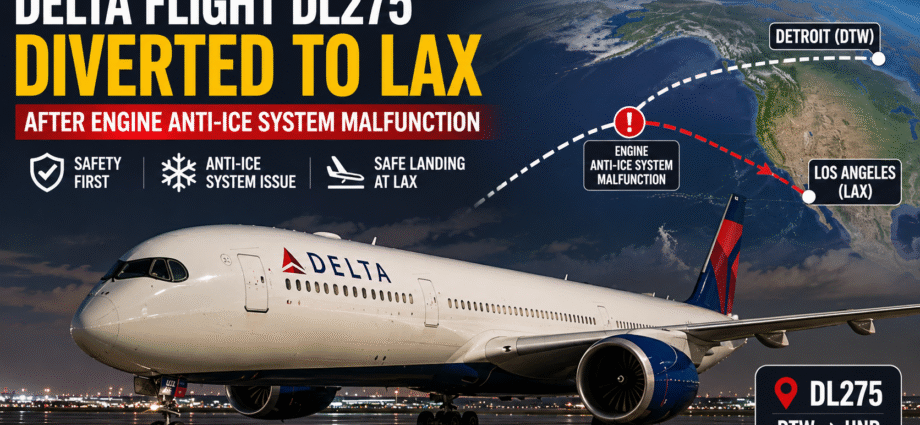
The Delta flight DL275 diverted LAX incident attracted attention after a Delta Air Lines Airbus A350-900 traveling from Detroit to Tokyo was forced to change course because of a technical issue. The flight was operating from Detroit Metropolitan Wayne County Airport (DTW) to Tokyo Haneda Airport (HND) when the crew detected a malfunction involving the aircraft’s engine anti-ice system. Rather than continuing a long transpacific journey with a system problem that could potentially affect safe operations, the pilots made the decision to turn the aircraft around and head toward the United States.
The aircraft eventually landed safely at Los Angeles International Airport (LAX), where passengers and crew could be supported while maintenance specialists examined the aircraft. While the incident may have concerned travelers, the diversion showed how flight crews manage technical issues by putting passenger safety first and selecting an airport equipped to handle the situation and maintenance resources.
The Flight From Detroit to Tokyo
Delta flight DL275 was scheduled to operate a long-haul international service between Detroit and Tokyo. Flights on this route can take many hours and cross large areas of the Pacific, meaning aircraft systems must remain reliable throughout the journey. The aircraft involved was an Airbus A350-900, a modern wide-body aircraft designed for long-distance operations. After departing Detroit, the flight proceeded westward toward its destination in Japan. At some point during the journey, the crew became aware of an issue affecting the engine anti-ice system.
The problem required careful consideration because the aircraft still had a significant distance to travel before reaching Tokyo. Instead of accepting unnecessary risk over a remote oceanic area, the crew evaluated the available options and decided that returning toward the United States was the more prudent course of action.
What Is an Engine Anti-Ice System?
An aircraft’s engine anti-ice system is designed to help protect critical engine components from ice accumulation when conditions could cause icing. At cruising altitude, aircraft can encounter extremely cold temperatures, moisture, and other atmospheric conditions that can create ice around vulnerable areas. Ice accumulation in or around an engine can interfere with normal airflow and potentially affect engine performance.
Anti-ice systems therefore play an important role in maintaining reliable engine operation when icing conditions are present or expected. A malfunction does not automatically mean that an aircraft is in immediate danger, but it can place limitations on how the aircraft should be operated in certain conditions. For a long international flight across the Pacific, the crew has to consider the remaining route, weather, aircraft systems, fuel requirements, and available diversion airports before deciding whether to continue.
Why the Crew Decided to Turn Back
The decision to turn around was primarily a precautionary safety measure. Continuing toward Tokyo would have meant spending many more hours over the Pacific while dealing with a known technical issue. Even when an aircraft remains capable of flying, pilots are trained to avoid unnecessary exposure to situations that could become more complicated later in the journey.
Turning back toward the United States provided access to airports, maintenance teams, replacement equipment, and other resources. Reports indicated that the aircraft spent several hours flying back toward the U.S. mainland before eventually arriving at Los Angeles. For passengers, such a lengthy return can be frustrating because it adds significant time to the journey, but from an operational perspective, returning to a suitable maintenance location can be the safest and most practical choice.
Why Was Los Angeles Chosen?
One of the most interesting aspects of the Delta flight DL275 diverted LAX story is the decision to land at Los Angeles rather than simply choosing another airport. Los Angeles International Airport is an important location within Delta’s network and offers extensive airline infrastructure.
For a wide-body aircraft such as the Airbus A350-900, access to appropriate maintenance personnel and technical equipment can be an important consideration when selecting a diversion airport. LAX also provides substantial passenger-handling capabilities, which can become especially valuable when a long-haul flight arrives unexpectedly. Once the aircraft was on the ground, Delta could work on passenger arrangements while technical personnel investigated the reported malfunction. Choosing a major airline station can therefore make the aftermath of a diversion considerably easier to manage.
The Importance of Maintenance Support at LAX
A technical diversion is not simply about finding a runway long enough for an aircraft to land. Airlines also need to consider what happens after the aircraft reaches the ground. A modern Airbus A350 contains highly sophisticated systems that may require specialized diagnostic equipment and trained technicians. A major airport such as LAX can provide better access to maintenance capabilities than a smaller regional airport.
This is particularly important when the aircraft requires inspection before it can return to normal passenger service. Maintenance teams can examine the anti-ice system, identify the source of the malfunction, and determine what repairs or further inspections are necessary. The availability of airline personnel and support infrastructure can also help the carrier manage passengers, baggage, crew schedules, aircraft replacement plans, and onward travel.
What Happened After the Safe Landing?
The aircraft landed safely at Los Angeles International Airport, bringing the precautionary diversion to an end. There was no indication from the information provided that the aircraft experienced a crash or that passengers faced an emergency landing situation. Instead, the event was handled as a technical diversion designed to reduce risk. After landing, attention would naturally shift toward inspecting the aircraft and determining the best way to continue the passengers’ journey. Depending on the findings, an airline may repair the aircraft, replace equipment, arrange another aircraft, or reschedule the affected flight. Passenger disruptions can be significant after a long-haul diversion, but the primary objective remains ensuring that the aircraft is technically fit before another departure.
Why Diversions Are Part of Aviation Safety
The Delta flight DL275 diverted LAX case highlights an important principle in commercial aviation: pilots do not need to wait for a serious emergency before choosing to land elsewhere. Diversions can be made whenever continuing a flight presents unnecessary operational concerns. Airlines operate under detailed safety procedures, and flight crews constantly monitor aircraft systems throughout a journey. If a warning or malfunction occurs, pilots assess the situation using aircraft procedures, weather information, fuel calculations, airport availability, and the condition of the aircraft. A diversion can therefore be viewed as evidence of a safety system working as intended rather than automatically as a sign of catastrophic failure.
What Passengers Can Learn From the Incident
For passengers, the incident offers a useful reminder that flight diversions can happen for many reasons, including weather, medical situations, mechanical concerns, airport conditions, or operational requirements. A diversion can cause delays and inconvenience, but it is often preferable to continuing a flight when the crew believes another airport provides a safer or more practical option. In this case, the anti-ice system issue was treated seriously enough to justify changing the flight plan. The decision to land at a major Delta location also gave the airline greater flexibility to inspect the aircraft and manage passengers. While travelers understandably want to reach their destination on time, aviation safety procedures are designed to put safe operation ahead of schedule.
The Broader Significance of Delta Flight DL275
The Delta flight DL275 diverted LAX incident also demonstrates the complexity of operating long-distance international flights. A flight from Detroit to Tokyo crosses thousands of miles and requires careful planning for fuel, weather, aircraft performance, crew operations, and possible diversions.
When a technical problem appears during such a journey, pilots must think beyond the immediate situation and consider what could happen several hours later. Returning toward an airport with strong airline support can provide a greater safety margin and make the technical issue easier to address. The incident ultimately ended with a safe landing, showing how established aviation procedures can help crews manage unexpected problems without turning them into more serious events.
Conclusion
The Delta flight DL275 diverted LAX after the crew identified a malfunction involving the aircraft’s engine anti-ice system during its journey from Detroit to Tokyo. Rather than continuing across the Pacific with a known technical concern, the pilots chose a precautionary diversion toward Los Angeles.
The choice of LAX provided access to Delta’s operational network, passenger services, and maintenance resources capable of supporting an Airbus A350-900. Most importantly, the aircraft landed safely, and the situation illustrates why commercial aviation places such a strong emphasis on preventative decision-making. For passengers, the diversion may have created delays and uncertainty, but the crew’s decision reflects a fundamental aviation principle: when a technical concern arises, safety takes priority over completing the original flight plan.
FAQs
1. Why Was Delta Flight DL275 Diverted to LAX?
Delta flight DL275 was diverted to Los Angeles after the crew detected a malfunction involving the aircraft’s engine anti-ice system. The diversion was made as a precaution rather than waiting for the problem to potentially become more serious during the long journey to Tokyo.
2. What aircraft was operating Delta flight DL275?
The flight was operated by an Airbus A350-900, a modern wide-body aircraft commonly used for long-distance international routes. The aircraft is designed for extended flights and includes sophisticated systems that require specialized maintenance support.
3. Why did the pilots choose Los Angeles?
Los Angeles International Airport offered important operational advantages, including Delta’s presence and access to suitable maintenance facilities and technical support. The airport also has extensive resources for handling passengers following an unexpected diversion.
4. Was Delta flight DL275 an emergency?
The available information indicates that the diversion was a precautionary safety decision related to a technical malfunction. The aircraft landed safely at LAX, and the situation should not automatically be interpreted as a catastrophic emergency.
5. What happens after an aircraft diverts because of a technical problem?
After landing, maintenance specialists normally inspect the aircraft and determine the cause of the problem. The airline then decides whether the aircraft can be repaired and released for service or whether another aircraft or alternative travel arrangements are required for passengers.
READ MORE: clocktimes