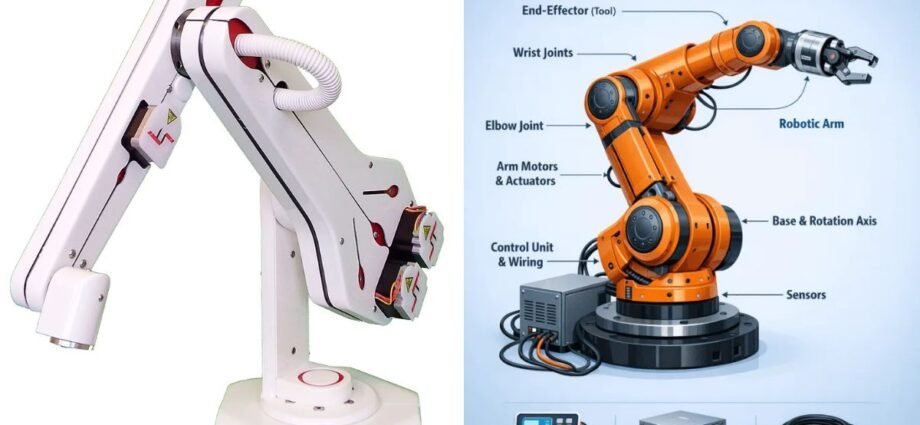
Industrial automation has transformed modern manufacturing, and one of the biggest reasons behind this transformation is the widespread use of industrial robotic arms. These advanced machines are designed to perform repetitive, complex, and high-precision tasks with remarkable speed and consistency. Whether assembling delicate electronic components or welding heavy automotive structures, industrial robotic arms play a vital role in modern manufacturing across a wide range of industries.
Understanding how industrial robotic arms work helps explain why they are so valuable in today’s factories. Rather than operating like simple machines that repeat fixed movements, industrial robotic arms combine intelligent software, precision motors, mechanical engineering, and advanced sensors to perform highly accurate tasks. Every movement is carefully calculated, monitored, and adjusted in real time to achieve consistent results. This combination of hardware and software allows robotic arms to increase productivity, improve product quality, and reduce workplace risks while operating around the clock with minimal downtime.
Essential Parts That Make an Industrial Robotic Arm Function
Every industrial robotic arm is built around several key components that work together as one complete system. Each part has a specific responsibility, and the robot cannot function efficiently without all of them operating in harmony.
The controller acts as the robot’s brain. It receives instructions from programmed software, calculates movement paths, coordinates each motor, and constantly processes information from sensors. The controller determines exactly when and how every joint should move while ensuring smooth, accurate operation throughout every task.
Another essential component is the actuator, usually a high-performance servo motor. These motors convert electrical energy into controlled mechanical movement. Every joint contains its own motor, allowing the robotic arm to rotate or extend with exceptional precision. Unlike standard electric motors, servo motors continuously receive feedback that helps maintain accurate positioning.
The mechanical structure consists of rigid links connected by movable joints. Manufacturers commonly use lightweight yet durable materials such as aluminium, steel, or carbon fibre to provide strength without sacrificing efficiency. These links function much like the bones in a human arm, giving the robot flexibility while supporting heavy loads.
At the end of the arm sits the end effector, often called the robot’s hand. Depending on the task, this attachment may be a vacuum gripper, mechanical gripper, welding torch, spray gun, polishing tool, laser cutter, or specialised inspection device.
Understanding Robot Movement and Degrees of Freedom
One of the most fascinating aspects of industrial robotics is the ability to move accurately through three-dimensional space. Most industrial robotic arms feature between four and six rotary joints, although advanced systems may include additional axes for even greater flexibility.
Each movable joint provides one Degree of Freedom (DoF). A standard six-axis robot can move forward, backwards, left, right, upward, and downward while also rotating its wrist in multiple directions. This enables the robot to approach objects from almost any angle, making it suitable for complicated manufacturing tasks.
The robot’s movement is controlled using sophisticated mathematical calculations known as kinematics. Forward kinematics determines the current position of the robot’s end effector based on the angle of each joint. Inverse kinematics works in the opposite direction by calculating the exact joint angles required to reach a desired position. These calculations happen within milliseconds, allowing the robot to execute smooth and highly accurate movements.
The Importance of Sensors and Real-Time Feedback
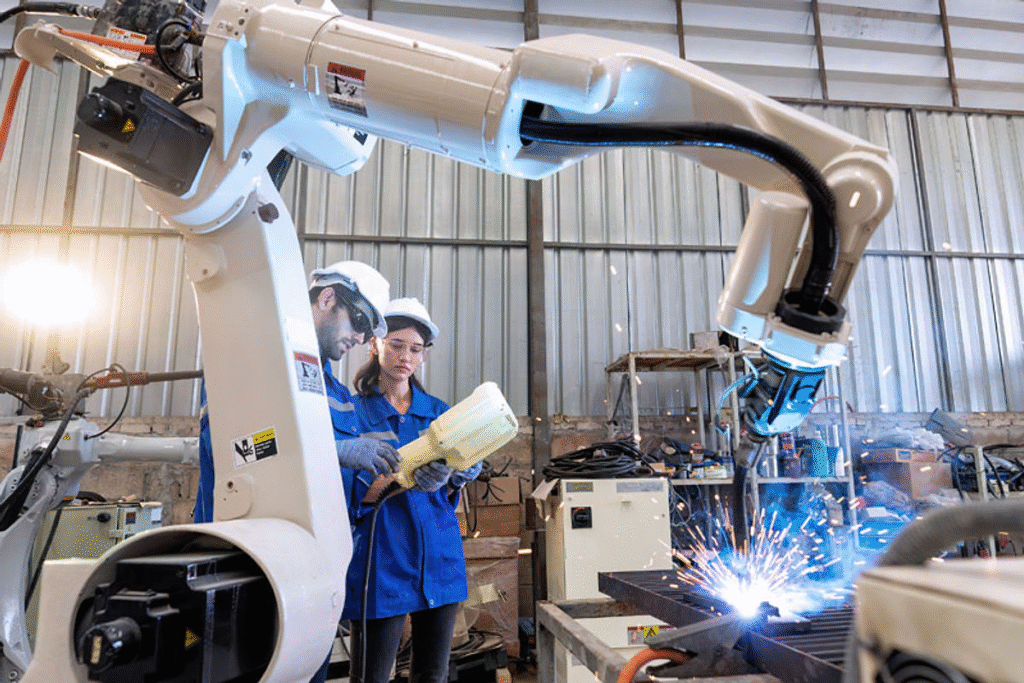
Industrial robotic arms do not simply move according to fixed commands. Instead, they constantly monitor their own movements through a closed-loop feedback system. This continuous communication allows the controller to detect even the smallest positioning errors and correct them instantly.
One of the most important sensing devices is the rotary encoder. Installed inside each servo motor, encoders measure the exact angle of every joint and transmit this information back to the controller. If the robot moves slightly away from its intended position, the controller immediately adjusts the motor to restore accuracy.
Many robotic systems also include force and torque sensors positioned near the wrist. These sensors measure the amount of pressure applied while handling objects. This feature is particularly useful when assembling fragile products, tightening fasteners, or working alongside delicate components where excessive force could cause damage.
Advanced robotic systems also incorporate machine vision. Cameras combined with intelligent image-processing software enable robots to identify products, recognise orientations, inspect defects, and locate moving objects on conveyor belts. Vision systems allow robotic arms to adapt automatically to changing production conditions without requiring constant human intervention.
How Industrial Robotic Arms Are Programmed
Programming is what transforms a robotic arm from a mechanical machine into an intelligent manufacturing system. Engineers typically use one of two programming methods depending on the complexity of the application.
The first method involves a teach pendant, which is a handheld control device connected directly to the robot. Operators manually guide the arm through each required movement while recording important positions. Once these points are stored, the robot can repeat the entire sequence with outstanding consistency.
The second method is offline programming. Engineers create a complete digital simulation of the manufacturing process using specialised software. They develop, test, and optimise robot movements within the virtual environment before transferring the finished program to the physical robot. This approach minimises production interruptions and significantly reduces installation time.
Many factories integrate robotic arms with Programmable Logic Controllers (PLCs). The PLC coordinates communication between robots, conveyor systems, sensors, packaging machines, and safety equipment. This integration ensures every part of the production line works together efficiently.
Common Industrial Applications
Industrial robotic arms are used across a wide variety of industries because of their ability to perform repetitive and precision-based tasks without fatigue. In automotive manufacturing, robots perform welding, painting, assembly, and material handling with remarkable consistency. Electronics manufacturers use robotic arms for placing tiny components on circuit boards where extreme precision is required.
Food and beverage companies rely on robotic arms for packaging, sorting, palletising, and quality inspection. Pharmaceutical manufacturers use robots to handle sterile materials while reducing contamination risks. Warehouses employ robotic systems for order picking, pallet movement, and inventory management, helping businesses process orders faster and more accurately.
Benefits of Industrial Robotic Arms
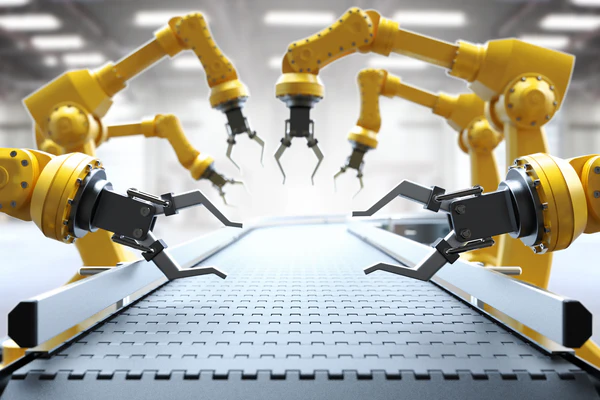
The growing popularity of industrial robotics is driven by the many advantages these systems provide. One major benefit is improved productivity. Robots can operate continuously with very little downtime, enabling manufacturers to increase production without sacrificing quality.
Another significant advantage is consistent accuracy. Unlike human workers who may experience fatigue during repetitive tasks, robotic arms maintain the same level of precision throughout every production cycle. This consistency reduces manufacturing defects and minimises material waste.
Industrial robots also contribute to workplace safety by handling hazardous tasks involving high temperatures, heavy lifting, toxic chemicals, or dangerous machinery. Employees can focus on supervision, maintenance, and quality control while robots perform physically demanding operations.
Although robotic systems require a substantial initial investment, they often reduce long-term operating costs through higher efficiency, fewer production errors, lower waste, and increased output. As technology continues to improve, robotic arms are becoming more affordable and accessible for businesses of all sizes.
Conclusion
Understanding how industrial robotic arms work reveals why they have become one of the most important technologies in modern manufacturing. By combining intelligent controllers, powerful servo motors, precision mechanics, advanced sensors, and sophisticated programming, these machines perform complex tasks with exceptional speed and reliability. Their ability to work continuously, adapt to changing production requirements, and deliver highly consistent results makes them an invaluable asset across industries ranging from automotive and electronics to healthcare and food processing. As robotics and artificial intelligence continue to evolve, industrial robotic arms will play an even greater role in shaping the future of automated manufacturing.
Frequently Asked Questions
1. How do industrial robotic arms work?
Industrial robotic arms work by combining a controller, servo motors, mechanical joints, sensors, and programmed software to move an end effector accurately while performing automated manufacturing tasks.
2. What is the purpose of a robotic arm controller?
The controller acts as the robot’s brain by processing instructions, calculating movement paths, coordinating motors, and monitoring sensor feedback for precise operation.
3. Why do industrial robotic arms use servo motors?
Servo motors provide highly accurate positioning, smooth movement, and continuous feedback, making them ideal for precision industrial applications.
4. What industries commonly use industrial robotic arms?
Industrial robotic arms are widely used in automotive manufacturing, electronics production, food processing, pharmaceuticals, warehousing, packaging, aerospace, and metal fabrication.
5. What are the biggest advantages of industrial robotic arms?
The primary benefits include higher productivity, improved accuracy, consistent quality, enhanced workplace safety, reduced production costs, and the ability to operate continuously with minimal downtime.
READ MORE: clocktimes