
In today’s digital economy, businesses generate enormous amounts of information every day. Customer purchases, website visits, marketing campaigns, financial transactions, and operational activities all create valuable data. However, raw data alone has little value unless someone can organise, analyse, and transform it into meaningful insights. This is where a business intelligence analyst plays an important role.
A business intelligence analyst helps organisations understand their historical and current performance by collecting, analysing, and presenting data in a way that supports smarter decision-making. Rather than relying on assumptions, companies use data-driven insights to improve efficiency, reduce costs, identify new opportunities, and stay ahead of competitors. Whether working for a healthcare provider, financial institution, retail company, or technology firm, these professionals help executives make confident business decisions based on facts instead of guesswork.
As businesses continue embracing digital transformation, the demand for skilled business intelligence analysts continues to grow. This career combines technical expertise with business knowledge, making it an excellent choice for individuals who enjoy solving problems, working with data, and helping organisations succeed.
What Is a Business Intelligence Analyst?
A business intelligence analyst is a professional responsible for collecting, organising, interpreting, and presenting business data to support strategic decisions. They gather information from multiple systems, clean and validate the data, create reports, and build interactive dashboards that help managers understand business performance.
Unlike professionals who only focus on statistical research, a BI analyst concentrates on delivering practical insights that improve daily operations and long-term planning. Their work enables leaders to identify trends, monitor key performance indicators, forecast future outcomes, and evaluate business strategies. By turning complex information into easy-to-understand visual reports, they help every department make better decisions based on reliable data.
Primary Responsibilities of a Business Intelligence Analyst
A business intelligence analyst performs a wide variety of tasks throughout the data analysis process. One of their main responsibilities is gathering data from multiple databases using SQL. Since business information often comes from different departments, they combine these datasets into one organised structure for analysis.
Another important responsibility is cleaning data to remove duplicate records, missing values, and inconsistencies. High-quality data leads to more accurate reporting and reliable business insights.
Creating dashboards is also a major part of the role. Using tools such as Power BI, Tableau, or Looker, analysts develop visual reports that display sales performance, customer behaviour, financial metrics, and operational efficiency. These dashboards allow executives to monitor performance without manually reviewing thousands of rows of data.
BI analysts also identify trends, compare historical performance, prepare reports for leadership teams, automate recurring reports, maintain reporting systems, and collaborate with different departments to understand business needs.
Essential Skills Every Business Intelligence Analyst Needs
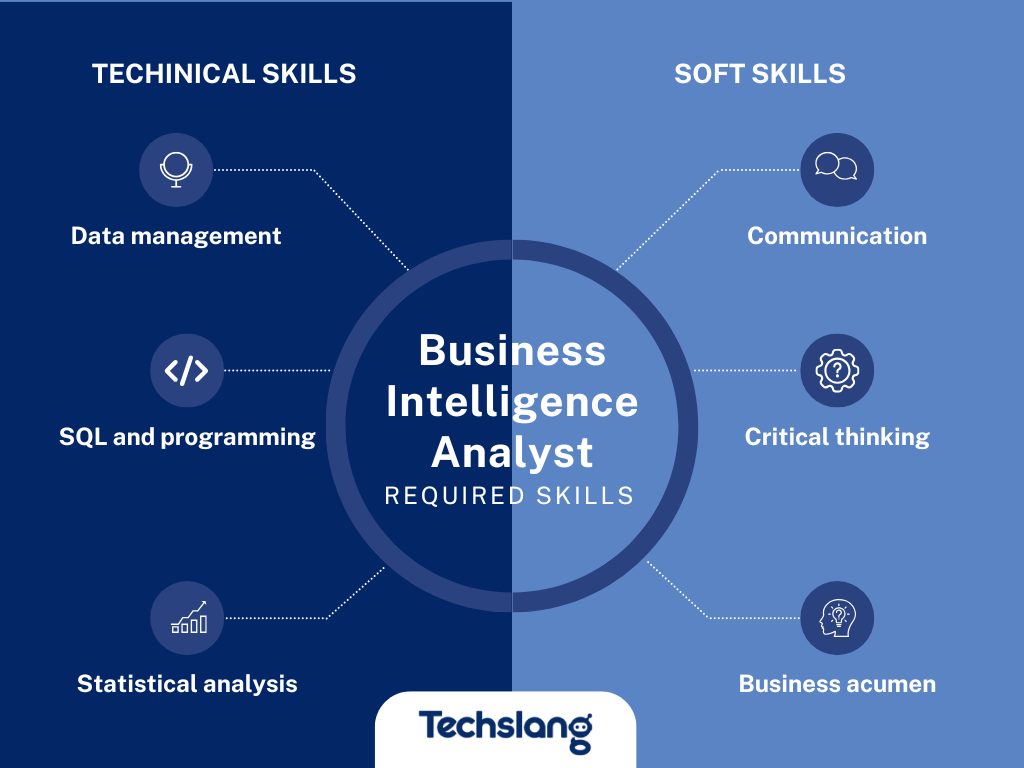
Success as a business intelligence analyst requires a combination of technical and analytical skills. Strong knowledge of SQL is essential because most business data is stored inside relational databases. Analysts use SQL queries to retrieve, filter, and organise information for reporting purposes.
Knowledge of Power BI, Tableau, and other visualisation platforms is equally important. These tools help transform raw numbers into interactive charts and dashboards that are easier to understand.
A solid understanding of ETL (Extract, Transform, Load) processes enables analysts to prepare data before analysis. Familiarity with cloud platforms such as Snowflake, Google BigQuery, and Amazon Redshift is becoming increasingly valuable as organisations migrate their data infrastructure to cloud environments.
Programming languages like Python or R provide additional capabilities for automation, predictive analysis, and advanced data processing. Alongside technical knowledge, communication, critical thinking, problem-solving, and attention to detail are equally valuable because analysts regularly explain complex findings to non-technical stakeholders.
Popular Tools Used by Business Intelligence Analysts
Modern organisations rely on numerous software solutions to support business intelligence projects. Microsoft Power BI is widely used because it integrates easily with Microsoft products and offers powerful dashboard capabilities. Tableau remains a popular choice for advanced visualisation and interactive reporting, while Looker is preferred by many cloud-based organisations.
Database management systems such as MySQL, PostgreSQL, Microsoft SQL Server, and Oracle Database serve as primary data sources. Cloud-based data warehouses such as Snowflake, Google BigQuery, and Amazon Redshift enable organisations to process and analyse large-scale datasets with greater speed and efficiency.
For automation and advanced analytics, many professionals also work with Python, R, Microsoft Excel, and data integration tools that simplify reporting workflows.
Business Intelligence Analyst vs. Data Analyst vs. Business Analyst
Although these careers often overlap, they have different objectives. A business intelligence analyst focuses on transforming business data into dashboards, reports, and performance metrics that help management monitor company operations. Their work emphasises ongoing reporting and business decision support.
A data analyst explores datasets to discover trends, relationships, and statistical patterns using analytical techniques and programming languages. Their projects often involve deeper investigations and predictive analysis.
A business analyst, on the other hand, concentrates on improving business processes, gathering project requirements, and helping organisations implement operational improvements. While they also use data, their primary focus is workflow optimisation rather than dashboard creation or technical reporting.
Career Path and Growth Opportunities
A career as a business intelligence analyst offers numerous advancement opportunities. Many professionals begin as junior data analysts or reporting specialists before moving into dedicated BI roles. As they gain experience with databases, visualisation tools, and cloud technologies, they often progress to senior analyst positions.
With additional expertise, professionals may advance into roles such as BI Developer, Analytics Manager, Data Engineering Specialist, Business Intelligence Architect, or even Chief Data Officer. Organisations across healthcare, finance, manufacturing, retail, logistics, education, telecommunications, and technology continue investing heavily in business intelligence, creating strong long-term career prospects.
Ongoing learning is essential for advancing professionally and staying competitive in the industry. Keeping up with emerging technologies, artificial intelligence, automation, and cloud analytics helps professionals remain competitive in a rapidly evolving industry.
Why Businesses Need Business Intelligence Analysts
Every organisation aims to make smarter decisions, improve efficiency, and maximise profitability. A skilled business intelligence analyst provides the insights needed to achieve these goals. By analysing customer behaviour, monitoring operational performance, tracking financial results, and identifying emerging trends, they help businesses reduce unnecessary costs and discover new growth opportunities.
Their reports also improve transparency across departments. Managers can monitor performance in real time, identify problems before they become serious, and evaluate whether business strategies are delivering the expected results. In today’s competitive marketplace, organisations that rely on accurate data often make faster and more informed decisions than those depending on intuition alone.
Conclusion
A business intelligence analyst plays a vital role in helping organisations transform raw information into meaningful business insights. Through SQL, visualisation tools, cloud platforms, and analytical thinking, these professionals provide the reports and dashboards that guide strategic decision-making. As companies continue generating larger volumes of data, the importance of business intelligence will only continue to grow. For individuals who enjoy combining technology, problem-solving, and business strategy, becoming a business intelligence analyst offers an exciting career with excellent opportunities for long-term growth and professional success.
Frequently Asked Questions
1. What does a business intelligence analyst do?
A business intelligence analyst collects, analyses, and presents business data through reports and dashboards to help organisations make informed decisions.
2. Which skills are most important for a business intelligence analyst?
Strong knowledge of SQL, Power BI, Tableau, data visualisation, cloud platforms, analytical thinking, and communication skills are highly valuable.
3. Is coding required for a business intelligence analyst?
Basic coding knowledge is beneficial. SQL is essential, while Python or R can be useful for automation and advanced analytics.
4. Which industries hire business intelligence analysts?
Healthcare, finance, retail, manufacturing, logistics, education, telecommunications, government, and technology companies all employ business intelligence analysts.
5. Is a business intelligence analyst a good career?
Yes. It is a rapidly growing profession with strong demand, competitive salaries, continuous learning opportunities, and excellent long-term career prospects across multiple industries.
READ MORE: clocktimes