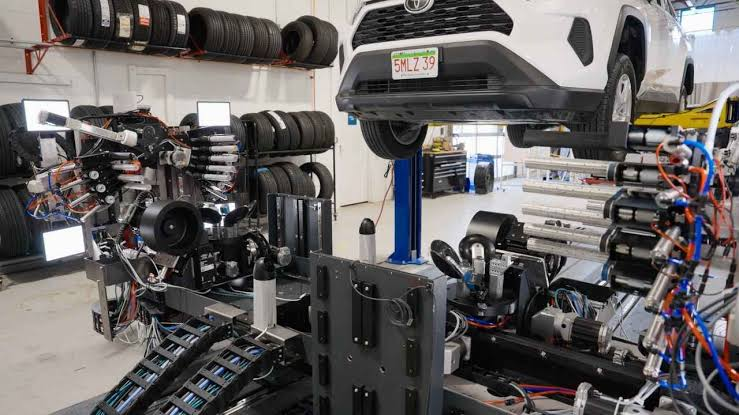
Automotive wheels must meet demanding quality standards because even small defects can affect appearance, assembly, balance, or long-term performance. As manufacturers increase production volumes, Automated Defect Detection for Wheel using machine vision ai is helping quality teams identify defects consistently without slowing production. At the same time, AI Assistance for Automated Wheel Inspection can turn conventional machine vision into a more intelligent inspection workflow that detects, classifies, and records defects automatically.
From cast and forged wheels to finished automotive wheel components, manufacturers need to inspect surfaces, edges, holes, spokes, and other critical areas. AI-powered vision provides an opportunity to automate these checks while reducing dependence on repetitive manual inspection.
Why Wheel Inspection Is Challenging
Automotive wheels have complex geometries. Depending on the design, a single wheel can contain multiple spokes, curved surfaces, mounting holes, edges, recesses, and different surface finishes.
Defects can also appear in many forms, including:
- Scratches
- Dents
- Cracks
- Casting defects
- Surface marks
- Porosity
- Pits
- Burrs
- Deformation
- Coating or finishing abnormalities
Some defects are obvious, while others can be small or difficult to distinguish from normal variations in the material.
Manual inspection can identify many of these issues, but inspecting every wheel consistently at high production speeds is challenging.
The Limitations of Manual Wheel Inspection
Human inspectors provide valuable visual judgment, but repetitive inspection can become difficult over long production shifts.
An inspector may need to examine hundreds or thousands of similar wheels, often under strict cycle-time requirements. Fatigue, lighting conditions, and differences in individual judgment can influence inspection results.
There is also a traceability challenge.
If a defective wheel is discovered later in the production process, manufacturers may need to determine when it was produced, where it was inspected, and what type of defect was identified.
An automated inspection system can address some of these challenges by creating a consistent digital inspection process.
How Machine Vision Inspects Wheels
A wheel inspection system typically combines industrial cameras, appropriate lenses, controlled lighting, image-processing hardware, and AI models.
The wheel is positioned in the inspection area, and cameras capture images of the required surfaces and features. Depending on the application, multiple cameras or different viewpoints may be used to cover areas that cannot be captured effectively from a single position.
The AI system analyzes the captured images and searches for patterns associated with known defects.
The inspection can then produce a result such as:
Pass → Accept the wheel
or
Fail → Identify and record the defect
This basic workflow can operate continuously alongside production.
AI for Detecting Surface Defects
Surface inspection is one of the most important applications of AI-powered wheel inspection.
Traditional vision systems often depend on predefined image-processing rules. These rules can work well for predictable defects, but manufacturing environments can contain significant variation in surface appearance.
AI-based inspection can learn from examples of acceptable and defective wheels.
Training data can include different defect types, surface finishes, lighting conditions, and normal manufacturing variations. The trained model can then analyze new wheel images and determine whether unusual patterns correspond to potential defects.
This approach can be useful when defects are difficult to define using simple geometric or threshold-based rules.
Inspecting Complex Wheel Geometry
The geometry of a wheel makes inspection more complicated than examining a flat surface.
Spokes, mounting holes, curved sections, inner surfaces, and edges can all require different inspection viewpoints.
A properly designed system can use multiple cameras and controlled lighting to capture these areas.
For example, one camera arrangement may focus on the front surface while another captures the inner or side areas. The system can combine these observations to create a more comprehensive inspection of the wheel.
The exact configuration depends on wheel dimensions, cycle time, defect size, surface characteristics, and the required inspection coverage.
More Than Simple Pass or Fail
AI can provide more information than a simple acceptance signal.
When a defect is detected, the system can potentially identify:
- Defect location
- Defect type
- Affected wheel
- Inspection image
- Inspection result
- Production information
This information can help operators and quality engineers understand what happened rather than simply knowing that a wheel failed.
For production teams, this can make defect handling faster and more systematic.
AI Assistance for Automated Wheel Inspection
The value of AI Assistance for Automated Wheel Inspection goes beyond identifying defective wheels.
An intelligent inspection workflow can connect visual inspection with operator alerts, production systems, quality records, and downstream decisions.
For example, when a defect is detected, the system can automatically trigger an alert, display the relevant inspection image, classify the issue, and record the result.
The workflow becomes:
Capture → Analyze → Detect → Classify → Alert → Record
This can reduce manual data entry and provide a more complete digital history of inspection results.
Improving Quality Traceability
Traceability is increasingly important in automotive manufacturing.
A digital wheel inspection system can create records associated with individual inspection events. Depending on the production environment, these records can contain images, defect classifications, timestamps, production information, and inspection outcomes.
Over time, this data can help manufacturers identify recurring patterns.
For example, if a particular defect begins appearing more frequently, quality engineers can investigate whether changes in tooling, raw material, machine settings, or finishing processes may be responsible.
AI inspection therefore has the potential to become a source of process intelligence, not merely a final inspection tool.
Detecting Defects Earlier
Finding a defective wheel immediately after a manufacturing operation is generally more useful than finding it after the component has passed through several additional processes.
Early detection can help manufacturers isolate problematic parts before they move downstream.
This can reduce the potential cost of:
- Rework
- Scrap
- Additional inspection
- Production disruption
- Customer complaints
- Quality escapes
Automated inspection can therefore contribute to both quality improvement and manufacturing efficiency.
Building a Reliable AI Inspection System
AI alone does not guarantee successful inspection.
The imaging environment must be designed carefully. Camera resolution, lens selection, working distance, lighting, wheel positioning, and image acquisition speed all influence the quality of the data presented to the AI model.
Training data is equally important.
The system should be exposed to representative examples of good wheels and realistic defect conditions. Rare or difficult defects should also be considered during validation.
Manufacturers should evaluate the complete inspection system rather than looking only at the AI model’s accuracy.
The Future of Wheel Quality Inspection
Automotive manufacturing is moving toward increasingly automated and connected quality-control systems.
Wheel inspection is a strong example of where this transformation can provide practical benefits. AI-powered machine vision can inspect complex surfaces and geometries at production speed while producing consistent and traceable results.
Rather than relying entirely on manual inspection, manufacturers can use AI to perform repetitive visual analysis while allowing operators and quality engineers to focus on exceptions, process improvement, and corrective actions.
The next generation of wheel inspection will therefore be about more than detecting defects. It will involve connecting inspection results with production processes, quality systems, and real-time decision-making.
Wheel quality has a direct relationship with the reliability and appearance of automotive products. As production requirements become more demanding, manufacturers need inspection methods that can keep pace without sacrificing consistency.
Automated Defect Detection for Wheel using machine vision ai provides a way to identify surface and manufacturing defects using industrial imaging and AI. Meanwhile, AI Assistance for Automated Wheel Inspection can transform inspection results into actionable information for operators and quality teams.
By combining cameras, controlled lighting, machine vision, AI models, and digital traceability, manufacturers can build a wheel inspection process that is faster, more consistent, and better connected to the overall production environment.