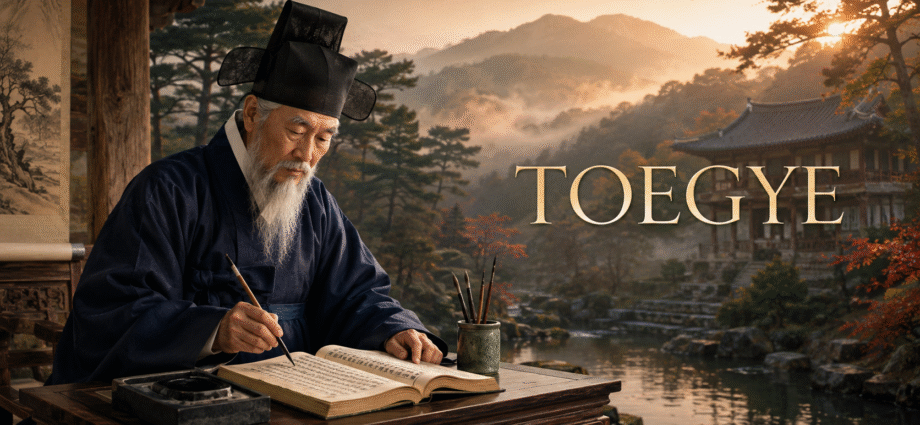
Toegye was the pen name of Yi Hwang, one of the most respected philosophers and educators in Korean history. Born in 1501 during the Joseon Dynasty, he devoted his life to scholarship, public service, moral development, and teaching. His interpretation of Neo-Confucianism influenced Korean thought for centuries and also reached scholars in Japan and other parts of East Asia. Modern audiences may recognize him as the historical figure shown on South Korea’s 1,000 won banknote, but his true importance lies in his ideas about human character, ethical conduct, and disciplined learning.
Who Was Toegye?
Yi Hwang was born in Ongye-ri, a village located in present-day Andong, South Korea. His father died when he was very young, so his mother played an important role in his education and character development. From childhood, he showed a strong interest in reading, reflection, and traditional Confucian texts. Rather than seeking wealth or personal fame, he believed that education should help people become morally responsible. The name Toegye, commonly understood as “Retreating Creek,” reflected his desire to leave political life and return to peaceful study near his home. Although he repeatedly attempted to withdraw from public office, his knowledge and reputation meant that the royal government continued to call upon him.
Education and Government Career
Toegye studied the Chinese classics, poetry, philosophy, history, and the works of important Confucian thinkers. He passed Korea’s demanding civil service examinations and began a long government career. Over the years, he received numerous appointments and served in positions connected with education, administration, and royal advice. Political life during the Joseon period could be dangerous because officials frequently faced factional conflict, accusations, and purges. Toegye preferred scholarship to political competition, yet he continued serving whenever he believed his knowledge could benefit society. His public career demonstrated that moral principles should guide leadership, even when political conditions are difficult.
Toegye and Neo-Confucianism
Neo-Confucianism developed from classical Confucian teachings but added deeper discussions about human nature, the universe, emotions, and moral knowledge. Toegye became one of Korea’s leading interpreters of this tradition. Much of his thinking was influenced by the Chinese philosopher Zhu Xi, but he did not simply repeat earlier ideas. He examined them carefully and developed explanations suited to Korean intellectual life. For Toegye, philosophy was not an abstract subject separated from ordinary experience. It was a practical method for correcting selfish behaviour, controlling harmful desires, respecting others, and developing the qualities expected of a wise person.
Understanding Li and Gi
Two important concepts in Toegye’s philosophy are Li and Gi. Li can be described as the universal principle, moral order, or pattern behind existence. Gi refers to the material energy through which everything takes physical form. Toegye gave special importance to Li because he believed moral values were grounded in a pure and universal order. However, human thoughts and actions appear through Gi, which can be clear, balanced, disturbed, or influenced by selfish desires. Personal development therefore requires careful reflection. A person must recognize sound moral principles while managing emotions and impulses that may prevent those principles from appearing clearly in daily behaviour.
The Four-Seven Debate
One of the most famous discussions in Korean philosophy was the Four-Seven Debate between Toegye and the younger scholar Gi Daeseung, also known as Gobong. The debate explored the origins of human emotions. The “Four Beginnings” referred to compassion, shame, respect, and the ability to distinguish right from wrong. These were viewed as the early signs of important virtues. The “Seven Emotions” included joy, anger, sorrow, fear, love, dislike, and desire. Through a detailed exchange of letters, the two scholars examined how Li and Gi operated within these emotional responses. Their debate was significant because it connected metaphysical ideas with real human feelings and moral choices.
Ten Diagrams on Sage Learning
Near the end of his life, Toegye prepared his celebrated work, Ten Diagrams on Sage Learning, for the young King Seonjo. The text combined diagrams with short explanations to make difficult philosophical principles easier to understand. It addressed the structure of the universe, human nature, education, moral discipline, and the responsibilities of leadership. Toegye wanted the king to study the diagrams regularly and apply their lessons while governing. The work teaches that becoming wise does not happen through knowledge alone. A person must practise self-examination, sincerity, respectful attentiveness, and responsible action. Its visual organization also made it an unusually practical educational text for its time.
Toegye as a Teacher
Teaching was central to Toegye’s life. He believed students should not merely memorize books or prepare for government examinations. Education was supposed to transform their habits, decisions, relationships, and sense of responsibility. He encouraged careful reading, quiet reflection, respectful discussion, and consistent practice. His approach attracted many students, and these followers later spread his ideas across Korea. Toegye treated learning as a lifelong process rather than a temporary path to employment. In his view, even a knowledgeable scholar needed to examine personal weaknesses and continue improving. This combination of intellectual study and character education became an important feature of his school of thought.
Dosan Seodang and Dosan Seowon
Toegye established Dosan Seodang, a small academy where he could study, write, and teach students in a peaceful environment. After his death, his followers expanded the site into Dosan Seowon, a Confucian academy and memorial institution. It became an influential centre of education, scholarship, and ceremonial remembrance. The natural setting reflected Toegye’s preference for a simple life close to mountains, streams, and quiet study. Dosan Seowon remains one of the most important places associated with him and forms part of Korea’s recognized Confucian academy heritage. It represents both his educational vision and the respect later generations showed for his teachings.
Influence on Korean Culture
Toegye’s followers helped establish the Yeongnam School, which became a major intellectual tradition during the Joseon Dynasty. His writings shaped debates about morality, government, education, and human emotions. His influence was not limited to scholars, because his values became connected with broader Korean ideas about respect, discipline, family responsibility, and learning. Streets, schools, research institutes, monuments, and cultural programs continue to carry his name. His image on the 1,000 won banknote further shows his place in South Korea’s national memory. Few philosophers remain so visible in both academic study and everyday public life centuries after their deaths.
Why Toegye Still Matters
Toegye remains relevant because he addressed a timeless question: how can people turn knowledge into good conduct? Modern societies have access to enormous amounts of information, yet information alone does not guarantee wisdom, honesty, or responsible leadership. His philosophy reminds readers that education should shape character as well as intelligence. His focus on reflection can also help people examine their emotions before reacting. Although his ideas emerged in a very different historical period, his emphasis on self-discipline, ethical leadership, sincere learning, and respect for others still offers practical value.
Frequently Asked Questions
What does Toegye mean?
Toegye was Yi Hwang’s pen name and is commonly interpreted as “Retreating Creek.” It reflected his wish to withdraw from politics and live quietly near a stream where he could study and teach.
Why is Toegye famous?
He is famous for developing Korean Neo-Confucian philosophy, educating influential students, participating in the Four-Seven Debate, and writing Ten Diagrams on Sage Learning.
Is Toegye shown on Korean currency?
Yes. Toegye appears on South Korea’s 1,000 won banknote, reflecting his importance as a philosopher, educator, and national historical figure.
What did Toegye teach about morality?
He taught that people could develop moral character through sincere study, self-reflection, respectful attentiveness, emotional discipline, and the regular practice of virtuous behaviour.
Where can Toegye’s legacy be seen today?
His legacy is visible at Dosan Seowon, in Korean educational traditions, scholarly research, public monuments, place names, cultural events, and South Korean currency.
Conclusion
Toegye was far more than a government official or historical scholar. He was a thoughtful educator who believed that genuine learning must improve both the mind and character. Through his explanations of Li and Gi, participation in the Four-Seven Debate, influential teaching, and Ten Diagrams on Sage Learning, he gave Korean Neo-Confucianism a powerful and lasting direction. His life demonstrates the value of principled leadership, disciplined study, and continuous self-improvement. Centuries after his death in 1570, Toegye remains an enduring symbol of wisdom, education, and moral responsibility.
READ MORE: clocktimes