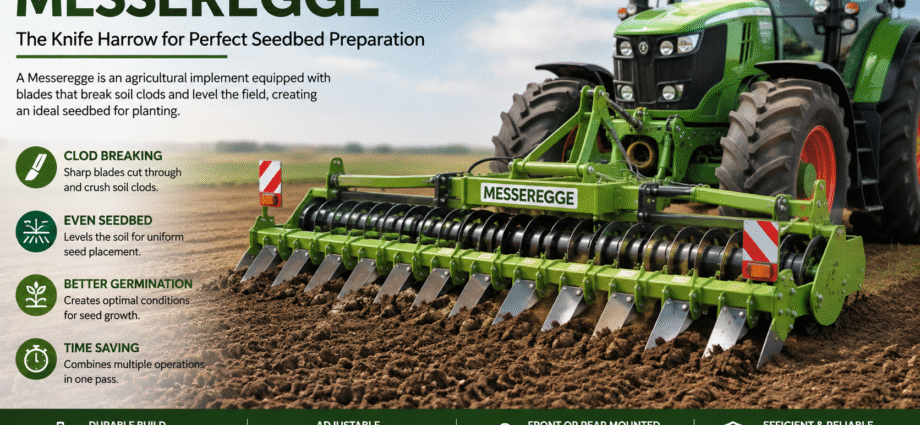
A Messeregge is a specialized agricultural implement designed mainly for soil preparation and seedbed finishing. The term comes from German agricultural terminology, with “Messer” referring to a knife or blade and “Egge” meaning harrow. For this reason, Messeregge can be understood as a knife harrow or blade-equipped harrow. Unlike a conventional harrow that primarily relies on tines or teeth, this implement uses blade-like working elements to act on clods and uneven soil.
Its main purpose is to break larger lumps of earth, level the surface, and help create soil conditions suitable for planting. Farmers may use it after primary tillage, particularly when plowing or other deep cultivation has left behind rough ground and compact clods. A well-prepared seedbed is important because seeds need appropriate contact with soil, relatively consistent planting depth, moisture, and enough loose earth for early root development. By improving the upper soil layer before sowing, a Messeregge can become a useful part of an efficient cultivation system.
How Does a Messeregge Work?
The working principle of a Messeregge is fairly straightforward. As the tractor moves forward, its blade elements pass through or across the cultivated upper layer and apply cutting, crushing, and leveling action to uneven soil. Instead of simply dragging through the field, the blades are arranged to work aggressively enough to reduce larger clods while preparing a more consistent surface.
The exact performance depends on the design of the implement, operating depth, tractor speed, soil moisture, previous cultivation, and soil type. On appropriately prepared land, the blades help transform a rough surface into finer material that can be easier to sow. Messeregge units can also be combined with equipment such as a front packer, roller, or other soil-working implement. In such a setup, different components perform complementary tasks during the same field pass.
The blades can reduce clods and redistribute loose material, while the roller or packer can consolidate and level the soil. Combining operations may reduce unnecessary field passes, although the best configuration always depends on field conditions and the crop being planted.
Why Seedbed Preparation Matters
Good seedbed preparation is much more than making a field look smooth. The physical condition of the soil can directly influence how consistently seeds are placed and how successfully young plants establish themselves. Large clods may interfere with seed placement, while an extremely loose or uneven surface can make maintaining a consistent sowing depth difficult. A Messeregge is intended to improve this final preparation stage by producing a more uniform upper layer.
The goal is not necessarily to pulverize every piece of soil into fine dust. Overworking the land can weaken its natural structure, making the surface more vulnerable to soil crusting and erosion in unfavorable conditions. Instead, effective preparation aims for an appropriate balance between fine soil around the seed and enough stable structure to support moisture movement and root growth. This makes correct timing especially important. Working soil that is excessively wet can cause smearing or compaction, while extremely dry and hard clods may require more energy to break. Farmers therefore need to judge field conditions rather than relying only on a fixed cultivation schedule.
Main Components and Design of a Messeregge
Although designs vary between manufacturers and models, a typical Messeregge consists of a strong supporting frame, mounting system, blade sections, adjustment mechanisms, and structural components that allow the machine to withstand continuous field use. The frame carries the working load and keeps the blades positioned correctly as the implement travels across uneven ground.
The blade elements are among the most important parts because they make direct contact with the soil and perform much of the clod-breaking action. Depending on the model, operators may be able to adjust the working position or intensity to suit different conditions. Some units are designed specifically for combination with rollers or packers, creating a more complete soil-preparation system. Working width is another practical consideration. Wider equipment can cover more land during each pass, but it also requires suitable tractor capacity, mounting arrangements, field access, and transport considerations. Choosing the right design therefore involves more than simply selecting the largest available machine.
Benefits of Using a Messeregge
One of the biggest advantages of a Messeregge is its ability to improve soil uniformity before sowing. Breaking down troublesome clods can make subsequent seeding operations more consistent and may help planting equipment maintain a steadier working depth. Another potential benefit is field efficiency, particularly when the implement is combined with other soil-working equipment. Performing multiple preparation actions during a single tractor pass can save operating time and may reduce fuel use compared with carrying out every task separately. Fewer unnecessary passes can also limit repeated wheel traffic across the field.
This implement is particularly valuable when earlier tillage leaves the field rough and the soil needs further levelling and refinement before planting. However, its effectiveness should not be considered universal. Heavy clay, light sandy soil, dry ground, wet fields, and soils with large amounts of crop residue can respond differently. The operator must match machine settings and working speed to actual conditions. Properly adjusted equipment usually produces better results than simply operating at maximum intensity.
Choosing the Right Messeregge for Farm Work
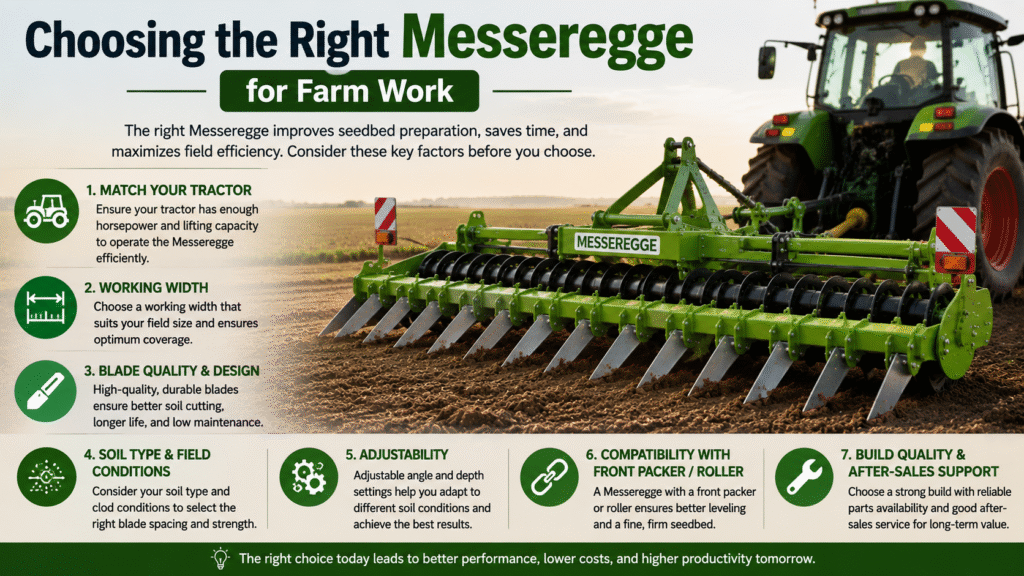
Selecting a Messeregge requires consideration of the tractor, soil, acreage, cropping system, and other equipment already used on the farm. Working width should match the tractor’s practical capabilities rather than being chosen solely for higher theoretical output. Farmers should also consider mounting compatibility, machine weight, adjustment options, blade durability, and whether replacement wear parts are readily available. Soil conditions are equally important.
A farm dealing regularly with heavy clods may prioritize robust construction and effective blade action, whereas another operation may need a machine mainly for light leveling and final seedbed finishing. Compatibility with a roller or front packer can also be valuable when the aim is to combine clod reduction with consolidation. Before field operation, settings should be tested over a small area. Examining the resulting soil structure provides a much better indication of performance than relying on one standard setting for every field.
Maintenance and Proper Care
Regular maintenance helps a Messeregge remain reliable and prevents small problems from developing into expensive failures. Because the blades and working parts repeatedly contact abrasive soil, they should be inspected for wear, bending, cracking, and loose mounting hardware. Worn blades may produce poorer results and can increase the effort needed to achieve the desired soil finish.
The frame, attachment points, bolts, adjustment mechanisms, and any moving components should also be checked regularly. Soil and plant material should be removed when buildup could interfere with operation or inspection. Before storage, cleaning the implement and addressing damaged or heavily worn components can make it easier to prepare for the next season. Operators should also follow the specific maintenance and safety guidance provided for their particular machine. Proper care does not only extend equipment life; it also helps maintain consistent working performance across the field.
Conclusion
The Messeregge is a practical soil-preparation implement whose main agricultural role is to break clods, level cultivated ground, and help create a suitable seedbed before planting. Its blade-based design distinguishes it from many traditional tine harrows and makes it particularly useful as a finishing tool after primary cultivation. Pairing it with rollers or packers can streamline soil preparation by completing several field tasks in fewer passes. Its results, however, depend heavily on soil conditions, correct adjustment, operating speed, and timely maintenance. Choosing an appropriate machine and using it according to field conditions allows farmers to get the greatest value from this specialized implement.
Frequently Asked Questions
1. What does Messeregge mean?
Messeregge is a German agricultural term combining words associated with a knife or blade and a harrow. It generally refers to a blade-equipped harrow used for soil and seedbed preparation.
2. What is a Messeregge used for?
A Messeregge is mainly used for breaking soil clods, leveling cultivated land, and refining the seedbed before sowing. It is commonly used after earlier tillage has left a rough surface.
3. Is a Messeregge the same as a normal harrow?
Not exactly. Conventional harrows often use tines, teeth, discs, or similar working elements, while a Messeregge is characterized by blade-like working components intended to provide cutting and clod-breaking action.
4. Can a Messeregge be used with a front packer?
Yes. Some Messeregge designs are intended to work alongside a front packer or roller, allowing clod breaking, leveling, and soil consolidation to take place as part of the same field operation.
5. Does a Messeregge work on every soil type?
Performance varies with soil texture, moisture, compaction, clod size, and machine settings. It can be effective in many cultivation systems, but operators should adjust working depth, speed, and intensity according to actual field conditions.
READ MORE: clocktimes