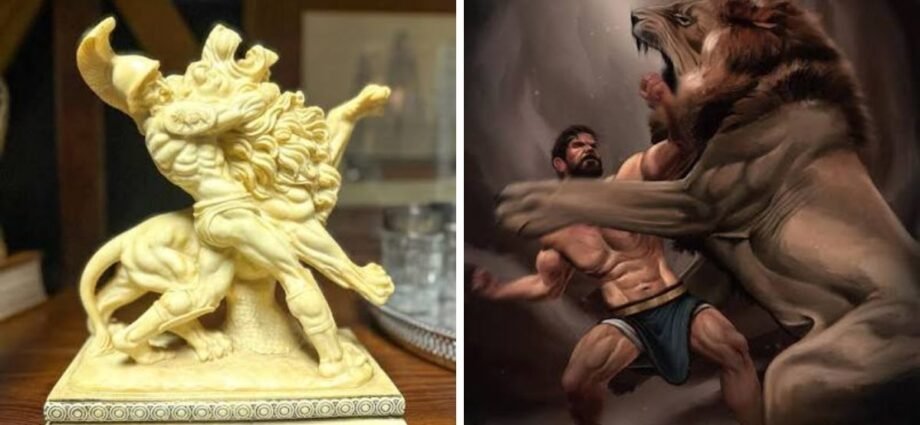
The Nemean Lion is one of the most famous creatures in Greek mythology, remembered as a powerful beast that challenged even the greatest heroes of ancient times. According to legend, this enormous lion lived near the region of Nemea and terrorised nearby communities by attacking people and defeating every warrior who attempted to stop it. Unlike ordinary animals, the Nemean Lion possessed magical golden fur that could not be pierced by normal weapons, making it almost impossible for humans to defeat. Its story became even more significant because killing this monster was the first challenge given to Heracles, the legendary Greek hero known for his strength, courage, and determination.
Origins and Mythical Background of the Nemean Lion
The origins of the Nemean Lion are surrounded by different myths and ancient traditions. In many classical stories, the creature was considered the offspring of Typhon and Echidna, two terrifying figures often described as the ancestors of many famous monsters in Greek mythology. Typhon was a powerful giant associated with storms and destruction, while Echidna was a half-woman, half-serpent creature who gave birth to several legendary monsters. This connection placed the lion among the most dangerous beings in Greek mythology.
Some alternative legends suggest that the lion had a divine origin connected to the gods. Certain stories claim that Selene, the moon goddess, was involved in creating or sending the beast, while others associate it with the will of Zeus. Another popular belief was that Hera, the wife of Zeus and Heracles’ enemy, intentionally sent the lion to Nemea as part of a plan to make Heracles face a deadly challenge. These different versions show how myths often changed over time while keeping the creature’s importance intact.
The lion eventually made its home in a cave near Nemea, a valley located in the northeastern part of the Peloponnese. The beast’s golden fur was not only beautiful but also provided supernatural protection. Swords, arrows, and other weapons could not harm it, which made the creature a symbol of an enemy that could not be defeated through ordinary methods.
Heracles’ First Labour: The Battle Against the Beast
The defeat of the Nemean Lion became the first of the Twelve Labours of Heracles, a series of difficult tasks assigned by King Eurystheus. Heracles was ordered to kill the lion and bring back proof of his victory. When he arrived in Nemea, he discovered that many warriors had already failed because they relied on traditional weapons that could not penetrate the animal’s magical hide.
Heracles first attempted to attack the lion with his bow and arrows, but he quickly realised that his weapons were useless against its golden fur. His sword also failed, bending against the creature’s powerful body. Understanding that strength and strategy were necessary, Heracles changed his approach. He tracked the lion to its cave, which had two entrances, and blocked one of them to prevent the beast from escaping.
After entering the dark cave, Heracles confronted the enormous animal at close range. He used his club to weaken the lion before engaging it with his incredible physical strength. Since no weapon could injure the creature, Heracles fought it with his bare hands. After a fierce struggle, he managed to overpower the beast and strangle it to death. This victory proved that intelligence and determination were just as important as physical power.
After killing the lion, Heracles faced another challenge. He wanted to remove the animal’s valuable hide, but ordinary knives and blades could not cut through the magical fur. According to legend, the goddess Athena guided him and suggested using the lion’s own claws, which were sharp enough to cut through its skin. Heracles successfully removed the hide and later wore it as a protective cloak.
Symbolism and Importance of the Nemean Lion
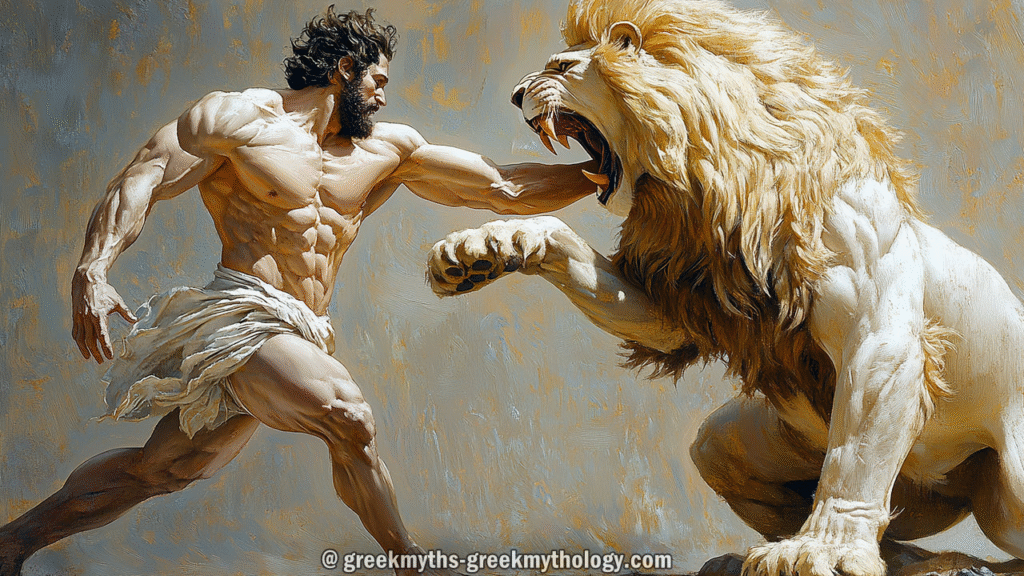
The Nemean Lion became much more than a defeated monster in Greek mythology. It represented the idea of overcoming impossible challenges through courage, creativity, and perseverance. The creature’s invulnerable armor symbolized obstacles that appear unbeatable, while Heracles’ victory demonstrated the importance of adapting when normal methods fail.
The lion’s skin became one of the most recognisable symbols associated with Heracles. Ancient artists frequently portrayed the hero wearing the lion’s hide over his shoulders, showing his victory and heroic status. The pelt represented both protection and power, becoming a visual reminder of his strength and bravery.
The story also reflects a common theme in Greek mythology: heroes often gain honour by facing dangers created by gods or supernatural forces. The battle between Heracles and the Nemean Lion showed the relationship between human effort and divine challenges, making it one of the most memorable heroic tales from ancient Greece.
The Nemean Lion in Art and Culture
The image of the Nemean Lion has continued to influence art, literature, and popular culture for centuries. Ancient Greek pottery, sculptures, and paintings often displayed Heracles carrying the lion’s skin as a sign of victory. The creature also became associated with the constellation Leo, as legends describe Hera placing the defeated lion among the stars after its death.
Even today, the story remains popular because it represents a timeless struggle between humans and overwhelming forces. The courage of Heracles and the fearsome nature of the lion continue to inspire modern books, films, games, and artwork. The legend survives because it combines adventure, mythology, and the universal message of facing difficult challenges.
Frequently Asked Questions About the Nemean Lion
1. What was the Nemean Lion?
The Nemean Lion was a mythical beast from Greek mythology known for its golden fur and incredible strength. It lived near Nemea and was famous for being impossible to defeat with ordinary weapons.
2. Who killed the Nemean Lion?
The legendary hero Heracles killed the Nemean Lion as the first task of his Twelve Labours. He defeated it by using his strength instead of weapons.
3. Why could weapons not harm the Nemean Lion?
The lion had magical, impenetrable fur that protected it from arrows, swords, and other human weapons. This made it one of the most dangerous creatures in Greek mythology.
4. What happened to the lion’s skin after it was defeated?
Heracles removed the lion’s hide and wore it as a powerful cloak. It became his most famous symbol and represented his heroic victory.
5. Is the Nemean Lion connected to the stars?
Yes, according to mythology, the defeated lion was placed in the sky and became the constellation Leo, preserving its memory forever.
Conclusion: The Eternal Legend of the Nemean Lion
The Nemean Lion remains one of the greatest legends of Greek mythology because it represents strength, bravery, and the ability to overcome impossible obstacles. Heracles’ victory against this unstoppable beast became the foundation of his legendary journey and established him as one of the greatest heroes of ancient Greece. Through myths, artwork, and storytelling, the tale of the Nemean Lion continues to inspire people around the world.
READ MORE: clocktimes